Mangystau: Mars on Earth (Complete Travel Guide 2026)
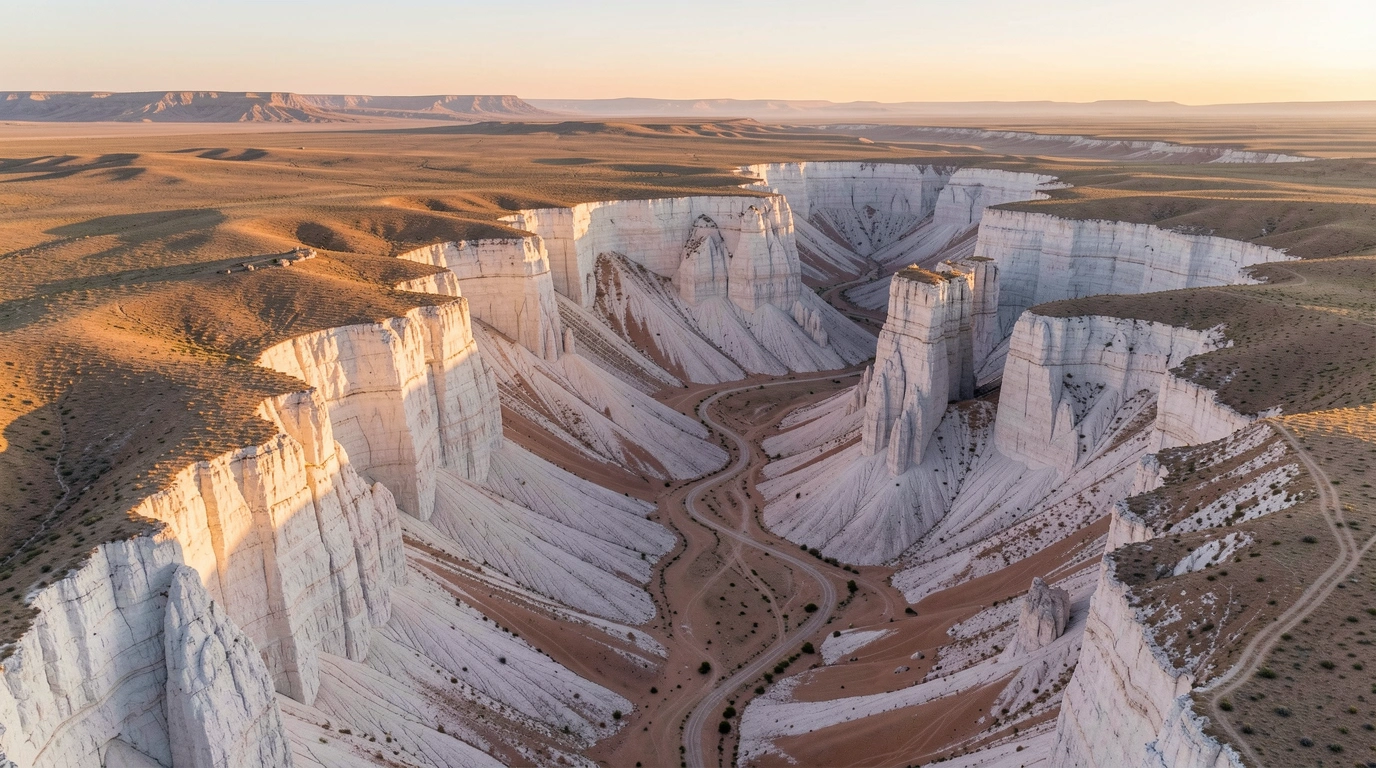
Mangystau (Kazakh: Маңғыстау) is a remote region in southwestern Kazakhstan where white chalk cliffs, underground mosques, and valleys filled with stone spheres create landscapes so surreal they are routinely compared to Mars. Located on the eastern shore of the Caspian Sea, Mangystau contains the fifth-deepest land depression on Earth (Karynzharyk, -132 meters below sea level), ancient Sufi pilgrimage sites, and geological formations dating back 180 million years, all with virtually no tourist crowds. It is one of the most extraordinary places to visit in Kazakhstan. According to Wikipedia’s entry on Mangystau Region, the area covers 165,600 km² and has a population of roughly 700,000, concentrated mainly in the city of Aktau.
Why Visit Mangystau?
Mangystau is not a mainstream destination. There are no resort hotels, no theme parks, no manicured hiking trails. What there is: raw, unfiltered landscapes that look like another planet, sacred sites that have drawn pilgrims for centuries, and the kind of emptiness that forces you to recalibrate your sense of scale.
What makes it unique:
- Geological formations 120-180 million years old
- Underground mosques carved into chalk cliffs by Sufi mystics
- The Torysh “Valley of Balls” with stone spheres up to 4 meters in diameter
- The Bozzhyra tract with 200-meter chalk towers rising from the steppe
- Caspian Sea beaches that are empty even in summer
- The Karynzharyk depression, fifth deepest point on Earth at -132 m
Top Attractions in Mangystau
Mangystau’s top sites span three categories: geological wonders (Bozzhyra, Torysh, Zhygylgan), sacred underground mosques (Beket-Ata, Shakpak-Ata, Shopan-Ata), and Caspian Sea landscapes. Every site requires a 4x4 vehicle and is at least 100 km from Aktau, so plan for multi-day tours to see more than one or two.
1. Bozzhyra Valley
The crown jewel of Mangystau. Bozzhyra (Kazakh: Бозжыра, “gray ravine”) is a vast canyon system of white chalk cliffs, towers, and mesas that formed from an ancient seabed over 50 million years ago. The two iconic “fangs” (twin towers rising 200+ meters from the canyon floor) are the most photographed landmarks in all of western Kazakhstan.
- Distance from Aktau: 270 km (4-5 hours, last 5 km unpaved)
- Best viewpoint: The main overlook platform on the canyon rim
- Time needed: Full day minimum; most tours combine with overnight camping
- Difficulty: The descent into the canyon requires a 4x4 vehicle and an experienced driver
2. Torysh Valley (Valley of Balls)
One of the most mysterious geological sites in Central Asia. The valley is covered with perfectly round stone concretions (spheres) ranging from fist-sized to 3-4 meters in diameter. According to Wikipedia’s article on Torysh, these concretions formed 120 to 180 million years ago through mineral crystallization around organic cores on the ancient seabed, a process known as concretion formation common in marine sedimentary environments.
- Distance from Aktau: 100 km northeast
- Access: Partially paved, last 10 km off-road
- Time needed: 2-3 hours
3. Shakpak-Ata Underground Mosque
A mosque carved directly into a chalk cliff face, believed to date from the 10th-12th centuries. According to Wikipedia’s entry on Shakpak-Ata, the site was a place where Sufi mystics performed spiritual healing and the structure contains four chambers oriented to the cardinal directions, with carved niches and ancient Arabic inscriptions still visible on the walls.
- Distance from Aktau: 120 km north
- Access: Good road, then 3 km unpaved
- Cultural note: Remove shoes before entering; this is still an active pilgrimage site
4. Beket-Ata Underground Mosque
The most revered pilgrimage site in western Kazakhstan. According to Wikipedia’s entry on Beket-Ata, he was an 18th-century Sufi saint, warrior, and scholar who chose to live and pray in a cave mosque beside a vast canyon. Thousands of Kazakhs make the pilgrimage annually.
- Distance from Aktau: 280 km
- Access: Paved road to Senek village, then unpaved; requires 4x4
- Time needed: Full day or overnight
5. Zhygylgan Collapsed Plateau
A massive section of the Ustyurt Plateau that collapsed, creating a circular depression roughly 500 meters across surrounded by sheer cliffs. The name means “fallen earth.” The geological event that created it is still debated, with theories ranging from underground cave collapse to ancient seismic activity.
- Distance from Aktau: 150 km north
- Access: Off-road only for the last 20 km
6. Sherkala Mountain
A solitary mesa rising from flat steppe that, from one angle, resembles a yurt and from another, a sleeping lion. “Sherqala” means “lion fortress” in Kazakh. At the base, remnants of an ancient caravanserai have been found, connecting the site to Silk Road trade routes.
- Distance from Aktau: 170 km
- Access: Paved road, visible from highway
7. Karynzharyk Depression
The fifth-deepest land depression on Earth at -132 meters below sea level. A dry, salt-crusted landscape that was once a Caspian Sea inlet. The sheer emptiness and silence here are overwhelming. The surrounding Kazakh steppe stretches to the horizon in every direction.
8. Caspian Sea Beaches
Mangystau has hundreds of kilometers of undeveloped Caspian Sea coastline. The water is calm, relatively warm (22-25C in summer), and the beaches are white shell-sand. Most are completely empty.
How to Get to Mangystau
The only practical way to reach Mangystau is by flying into Aktau Airport (SCO). Daily domestic flights connect Aktau to Almaty and Astana from $60 one-way. International options include Istanbul, London (seasonal), Baku, and Tbilisi. Overland travel from Almaty covers over 3,000 km and is only worthwhile when combining multiple western Kazakhstan destinations.
By Air (Recommended)
Aktau Airport (IATA: SCO) is the gateway to Mangystau, located 25 km from Aktau city center.
| Route | Frequency | Airlines | Approx. Price |
|---|---|---|---|
| Almaty to Aktau | Daily | Air Astana, SCAT, FlyArystan | $60-150 one-way |
| Astana to Aktau | Daily | Air Astana, FlyArystan | $70-160 one-way |
| Istanbul to Aktau | 2-3x/week | Turkish Airlines | $200-400 |
| London to Aktau | Weekly | Wizz Air (seasonal) | $150-350 |
| Baku to Aktau | 2x/week | SCAT, AZAL | $100-200 |
| Tbilisi to Aktau | Weekly | Georgian Airways | $120-250 |
FlyArystan (Kazakhstan’s low-cost carrier) offers the cheapest domestic fares, sometimes as low as 8,000 KZT ($16) on promotional sales.
By Train
Since August 2024, a Nukus (Uzbekistan) to Aktau train service operates, making it possible to combine Mangystau with an Aral Sea / Karakalpakstan itinerary.
From Almaty or Astana, trains to Aktau take 2-3 days and are not recommended unless you specifically want the experience.
By Car
Driving from Almaty: approximately 3,000 km (30+ hours). From Astana: approximately 2,500 km. Not practical unless combining with other western Kazakhstan destinations.
Tour Options and Costs (2026)
You cannot explore Mangystau independently without a 4x4 vehicle and GPS. Most visitors book organized jeep tours from Aktau.
| Tour Duration | Group Tour (per person) | Private Tour (per person) | What’s Included |
|---|---|---|---|
| 1 day (Bozzhyra or Torysh) | $110-150 | $180-250 | Transport, guide, lunch |
| 2 days (Bozzhyra + Torysh) | $250-320 | $350-450 | Transport, guide, meals, camping/yurt |
| 3 days (North Mangystau) | $400-500 | $575-700 | All meals, camping, guide |
| 5 days (Full Mangystau) | $700-810 | $900-1,200 | Comprehensive, all sites |
| 7 days (Extended) | $1,000-1,150 | $1,500-2,000 | All major + remote sites |
What’s typically included: 4x4 vehicle with driver, English-speaking guide, all meals (prepared by a camp cook), camping equipment or yurt stays, entrance fees, insurance.
Not included: Flights to Aktau, personal gear, tips.
Recommended Tour Operators
- Advantour (advantour.com): International operator, English-language support, group tours
- MangystauTour999 (mangystautour999.kz): Local operator, competitive prices
- Photosafari Travel (photosafari-travel.kz): Photography-focused tours with satellite phone included
- Turan Asia (turanasia.kz): Budget-friendly group options
- MJ Tour (mjtour.kz): Local operator, flexible custom tours
Best Time to Visit
| Season | Months | Temperature | Verdict |
|---|---|---|---|
| Spring | April-May | 18-28C (64-82F) | Best. Green steppe, comfortable camping, wildflowers |
| Summer | June-August | 35-42C (95-108F) | Very hot. Only for those who can handle extreme heat |
| Autumn | September-October | 18-28C (64-82F) | Excellent. Warm days, cool nights, golden light for photography |
| Winter | November-March | -5 to 8C (23-46F) | Stark beauty, but camping is brutal. Day trips from Aktau still possible |
April-May and September-October are optimal. The steppe briefly turns green in spring before the summer heat burns everything dry.
Practical Tips
Mangystau’s desert environment demands specific preparation. The three non-negotiables: enough water (3 liters per person per day minimum), offline maps downloaded before leaving Aktau, and cash for operators who don’t accept cards. Everything else on this list matters, but those three will determine whether your trip is a highlight or an emergency.
What to Bring
- Water: Minimum 3 liters per person per day (no water sources in the desert)
- Sun protection: Hat, sunscreen SPF 50+, long sleeves (UV is intense on white chalk)
- Warm layers: Desert nights drop 15-20 degrees from daytime temperatures
- Closed shoes: Scorpions, snakes, and thorns are real concerns
- Cash: No ATMs outside Aktau; some operators accept card but not all
- Offline maps: Cell service is nonexistent outside Aktau; download maps.me or Organic Maps
Safety
- Never travel alone; always go with at least one other vehicle
- Carry spare tires, a jack, pump, and extra fuel
- GPS with Mangystau-specific maps is essential (standard Google Maps shows nothing)
- Satellite phone recommended for multi-day trips
- Don’t camp near cliff edges (chalk is unstable and crumbles)
- Check food into closed containers at night (foxes and insects)
Accommodation in Aktau
Budget: 8,000-15,000 KZT ($16-30) per night Mid-range: 15,000-40,000 KZT ($30-80) Upscale: Rixos Water World Aktau, 60,000-150,000+ KZT ($120-300+)
Most travelers spend one night in Aktau before and after their desert tour.
Getting Around Mangystau
You need a 4x4 vehicle. Regular cars cannot handle the terrain. Options:
- Organized tour (recommended for first-timers): Everything handled by operator
- Hire a driver with vehicle: 40,000-60,000 KZT ($80-120) per day from Aktau
- Self-drive rental: Available from some agencies in Aktau, but only recommended for experienced off-road drivers with GPS navigation skills
Mangystau vs Other Kazakhstan Destinations
Mangystau is the right choice if you want raw wilderness, photography solitude, and geological history. Choose Almaty for mountains and accessibility, Astana for architecture and urban comfort. Mangystau requires more budget ($100-200/day including tours) and more time (minimum 3 days) than any other Kazakhstan destination, but it delivers landscapes found nowhere else on Earth.
| Feature | Mangystau | Almaty Region | Astana |
|---|---|---|---|
| Landscape | Chalk canyons, desert, sea | Alpine mountains, lakes | Flat steppe, modern city |
| Crowds | Almost none | Moderate on weekends | City crowds |
| Budget | $100-200/day (tours) | $30-80/day | $50-100/day |
| Best for | Adventure, photography, solitude | Hiking, nature, skiing | Architecture, culture |
| Access | Fly to Aktau + 4x4 tour | Drive from Almaty | Fly or train |
| Time needed | 3-7 days minimum | 1-5 days | 1-3 days |
Underground Mosques: Pilgrimage Sites of Western Kazakhstan
Mangystau contains more medieval underground mosques than any other region in Central Asia. Carved into chalk cliffs by Sufi mystics between the 9th and 18th centuries, these sites remain active pilgrimage destinations today. Three are within a day’s drive of Aktau; the most remote, Beket-Ata, requires a full-day expedition of 280 km each way.
Beket-Ata
The most spiritually significant site in all of western Kazakhstan. Beket-Ata (Бекет-Ата) was an 18th-century Sufi scholar, healer, and warrior who retreated to a canyon in the Ustyurt Plateau to build his fourth and final mosque in a natural cave. According to Wikipedia’s entry on Beket-Ata, he was born in 1750 and died in 1813, and is revered as a saint whose prayers are believed to have healing power.
Pilgrims descend a steep canyon path to reach the cave mosque, which contains a prayer hall, sleeping chambers, and a fireplace still used by visitors. The surrounding canyon landscape is itself spectacular, with layered chalk cliffs dropping toward a dry riverbed. Kazakhs often bring food to share at the site, maintaining a centuries-old tradition of communal hospitality at sacred sites. Allow a full day from Aktau (280 km one-way) or combine with an overnight camp at Bozzhyra, which lies nearby.
Shopan-Ata
Less visited than Beket-Ata but equally ancient, Shopan-Ata is a Sufi necropolis complex carved into chalk cliffs above the Caspian Depression, roughly 150 km north of Aktau. The site includes a mosque, a mausoleum, and a series of interconnected cave chambers used for meditation. According to Kazakhstani cultural heritage records, the complex dates to the 10th-11th centuries and is named after a Sufi master considered one of the early spiritual leaders of the Mangystau region.
The setting is dramatic: white chalk bluffs overlook a vast flat landscape stretching toward the horizon. Unlike Beket-Ata, Shopan-Ata receives few foreign tourists and has no organized facilities, making it one of the more authentic pilgrimage experiences in the region. Visit respectfully, dress modestly, and remove shoes before entering any prayer chamber.
Shakpak-Ata
The most accessible of the three (120 km from Aktau, mostly on paved road), Shakpak-Ata is the best introduction to Mangystau’s underground mosque tradition. The four-chambered mosque is carved directly into a vertical chalk face with intricate niches, columns, and Arabic inscriptions from the 10th-12th centuries still visible on the walls. It sits above a broad steppe valley, and the approach along the cliff edge provides wide views over the surrounding landscape.
Wildlife and Geology
Mangystau’s landscapes look alien because they genuinely record a vanished world. The chalk formations you walk through are the compressed remains of an ancient sea that covered the region 50-80 million years ago. Today, that same terrain supports wildlife that has adapted to one of the driest and most extreme environments in Kazakhstan.
Geological Background
The Mangystau region sits at the intersection of three ancient tectonic zones, which produced its dramatic variety of landforms within a relatively compact area. The white chalk cliffs at Bozzhyra and Shakpak-Ata formed from Cretaceous marine sediments, deposited when a shallow sea covered the region approximately 66-100 million years ago. The stone spheres at Torysh (concretions) formed later, 120-180 million years ago, through the precipitation of calcite and iron minerals around organic cores on the seabed floor.
The Ustyurt Plateau, which forms much of northern Mangystau, is a tabletop limestone plateau that remained above sea level while surrounding areas were flooded, creating the dramatic escarpments (chinks) at its edges, some rising over 300 meters. The Karynzharyk Depression at -132 meters sits below the current Caspian Sea level, remnant of an ancient inlet that dried as the Caspian shrank over thousands of years.
Wildlife
Despite its aridity, Mangystau supports a range of adapted species:
- Ustyurt saiga antelope: One of Earth’s oldest mammal species, saiga antelopes (Saiga tatarica) migrate across the Ustyurt Plateau in spring and autumn. According to the IUCN Red List, the global saiga population has partially recovered from near-extinction in the 1990s but remains vulnerable. Sightings are possible on the plateau in early morning.
- Steppe eagle and long-legged buzzard: Both nest on chalk cliff ledges throughout the region. Tour guides can usually identify nesting sites on routes to Bozzhyra.
- Caspian seal: The world’s only freshwater-adapted true seal species (Pusa caspica) inhabits the Caspian Sea and can occasionally be spotted on remote beaches north of Aktau.
- Transcaspian urial: A wild sheep subspecies found on the rocky slopes of the Karatau range within Mangystau, most active at dawn and dusk.
- Desert monitor lizard (Varanus griseus): Central Asia’s largest lizard, up to 1.6 meters long, commonly encountered near rock formations in summer months.
Snake awareness is warranted: the steppe viper (Vipera ursinii) is present in rocky terrain. Bites are rare but possible. Closed shoes and attention to where you place your hands on rocks are sufficient precautions.
Frequently Asked Questions
- How do I get to Mangystau Kazakhstan?
- Fly to Aktau Airport (SCO), which has daily flights from Almaty and Astana (from $60-160 one-way on FlyArystan or Air Astana), plus international flights from Istanbul, London, Baku, and Tbilisi. From Aktau, book a jeep tour or hire a 4x4 with driver to explore the desert attractions. Since August 2024, a train from Nukus (Uzbekistan) to Aktau also operates.
- How much does a Mangystau tour cost?
- A 1-day group tour costs $110-150 per person, a 2-day tour $250-320, and a comprehensive 5-day tour $700-810 per person. Private tours are 30-50% more expensive. Prices include 4x4 transport, guide, all meals, and camping equipment. Flights to Aktau are not included.
- When is the best time to visit Mangystau?
- April-May and September-October offer the best conditions with temperatures of 18-28C (64-82F). Spring brings brief green vegetation and wildflowers. Summer (June-August) exceeds 40C (104F) and is uncomfortably hot for camping. Winter is possible for day trips from Aktau but too cold for overnight desert camping.
- Can I visit Mangystau without a tour?
- Technically yes, but it is not recommended without a 4x4 vehicle, GPS with offline Mangystau maps, and desert driving experience. There are no roads, gas stations, or cell service between attractions. Most visitors book organized tours from Aktau for safety and convenience. If self-driving, never go alone and always carry spare fuel, water, and tires.
- What is Bozzhyra in Mangystau?
- Bozzhyra is a vast canyon system of white chalk cliffs and towers, 270 km from Aktau. Two iconic 200-meter towers (called 'fangs') rise from the canyon floor, creating landscapes compared to Mars. The formations are 50+ million years old, remnants of an ancient seabed. It is considered the most spectacular natural site in western Kazakhstan.
- Is Mangystau safe for tourists?
- Yes, Mangystau is safe. The main risks are environmental, not human: extreme heat in summer, remote areas without cell service, and difficult terrain requiring 4x4 vehicles. Always travel with a guide or in a group of at least two vehicles. Carry enough water (3 liters per person per day), sun protection, and a satellite phone for multi-day trips.
Last verified: March 2026
More Stories
travel
Aktau, Kazakhstan: Caspian Sea City and Mangystau Gateway
Aktau travel guide: beaches, Mangystau desert tours, flights, hotels, restaurants, and why this Caspian Sea city is Kazakhstan's fastest-growing destination.
nature
Charyn Canyon: Kazakhstan's Answer to the Grand Canyon
Charyn Canyon guide - Valley of Castles, how to get there from Almaty, best time, hiking, and why this 12-million-year-old gorge is worth it.
travel
Is Kazakhstan Worth Visiting? 10 Reasons Yes
Is Kazakhstan worth visiting? Honest assessment with 10 reasons, who it suits best, costs, safety, and practical tips. Find out why travelers love it.