Kazakhstan Traditions: 15 Living Customs From the Steppe
Kazakhstan traditions are a living system of customs rooted in nomadic steppe life that still shape daily behavior across the country, from the mandatory welcoming of guests with tea and a full dastarkhan spread, to elaborate wedding rituals like kyz uzatu and betashar, birth celebrations such as shildehana and tusau kesu, the national spring holiday Nauryz, eagle hunting, mounted horse games, dombra music, oral poetry contests, and a deep social code of respect for elders and gift-giving that governs family and public life in both rural villages and modern cities like Almaty and Astana.
According to Britannica, Kazakhstan sits at the crossroads of Central Asia, and its traditions reflect centuries of Turkic nomadic heritage blended with Persian, Mongol, Russian, and Islamic influences. What makes Kazakh customs remarkable is not just their age but their persistence. Unlike many countries where traditional practices have been reduced to festivals and museums, Kazakhstan’s core traditions remain functional: they organize social gatherings, govern family relationships, and define how communities interact on a daily basis. This guide covers 15 major traditions that any visitor or student of Kazakh culture should understand. For a broader overview that also covers music, clothing, and food, see our complete guide to Kazakhstan culture and traditions.
Hospitality Traditions: Dastarkhan and Welcoming Guests
Hospitality is the cornerstone of all Kazakhstan traditions. According to Britannica’s entry on Kazakh culture, in Kazakh culture a guest, even an unexpected one, is considered a blessing from God (Kazakh: “Qonaq keldi, yrys keldi,” meaning “A guest arrives, good fortune arrives”). Refusing to welcome a guest or failing to offer food and tea is one of the most serious social offenses in Kazakh society.
The Dastarkhan
The dastarkhan (дастарқан) is the traditional spread of food and drink laid out on a low table or cloth for guests. It is not simply a meal but a statement of respect, generosity, and family honor. A proper dastarkhan includes:
- Bread (nan or baursak), always placed in the center, never turned upside down
- Tea, poured from a kettle by the youngest woman at the table, always into piala (handleless cups), filled only halfway (a full cup signals you should leave)
- Dried fruits and nuts (kuraga, zhangak, kishmish)
- Dairy products (kurt, irimshik, kaymak)
- Sweets and candies
- Main dishes, served later, with beshbarmak being the most honored dish
The head of the household or the most senior man carves and distributes the meat. Specific cuts carry meaning: the head of the sheep is offered to the most honored guest or eldest man, the pelvic bone (zhanbas) to senior women, and the shin bone (asykty zhilik) to younger guests.
Bata, The Blessing
Every significant meal or gathering ends with bata, a spoken blessing offered by the eldest person present. The bata thanks the host, blesses the family, and asks for prosperity and health. Guests raise both hands, palms upward, and draw them down over their faces after the blessing. This practice predates Islam in the steppe but has merged with Islamic prayer traditions over the centuries. For more on how Islam and pre-Islamic beliefs coexist in Kazakhstan, see our guide to religion in Kazakhstan.
Rules of Guest Behavior
Kazakh hospitality comes with unwritten expectations for guests:
- Remove shoes when entering a home
- Accept at least some food and tea (refusing is considered rude)
- Do not sit with your back to the elders or the door
- Do not stretch your legs toward others
- Thank the host and offer bata or kind words before leaving
Wedding Traditions: Kyz Uzatu and Betashar
Kazakh weddings are multi-day events that bind two families together through a series of rituals, each with specific social meaning. According to Bureau of National Statistics of Kazakhstan, approximately 130,000 marriages are registered in Kazakhstan each year, with over 75% of couples incorporating at least kyz uzatu and betashar ceremonies into their celebrations. The full cycle can involve negotiations, gifts, ceremonies, and feasts spread over weeks or months. For the complete guide, see our dedicated article on Kazakhstan wedding traditions.
Kyz Uzatu, Farewell of the Bride
Kyz uzatu (қыз ұзату, “sending the girl off”) is the farewell ceremony held at the bride’s family home on the eve of her departure. It is one of the most emotional traditions in Kazakh culture. The bride’s female relatives sing zhar-zhar, a traditional call-and-response song about the sadness of parting and the hopes for the bride’s new life. The bride often weeps openly, and her parents give final blessings and advice.
The bride leaves her family home accompanied by a procession. Historically, this meant riding on horseback to the groom’s village, sometimes days away. Today, it typically involves a car convoy, but the ritual structure remains the same.
Betashar, Unveiling of the Bride
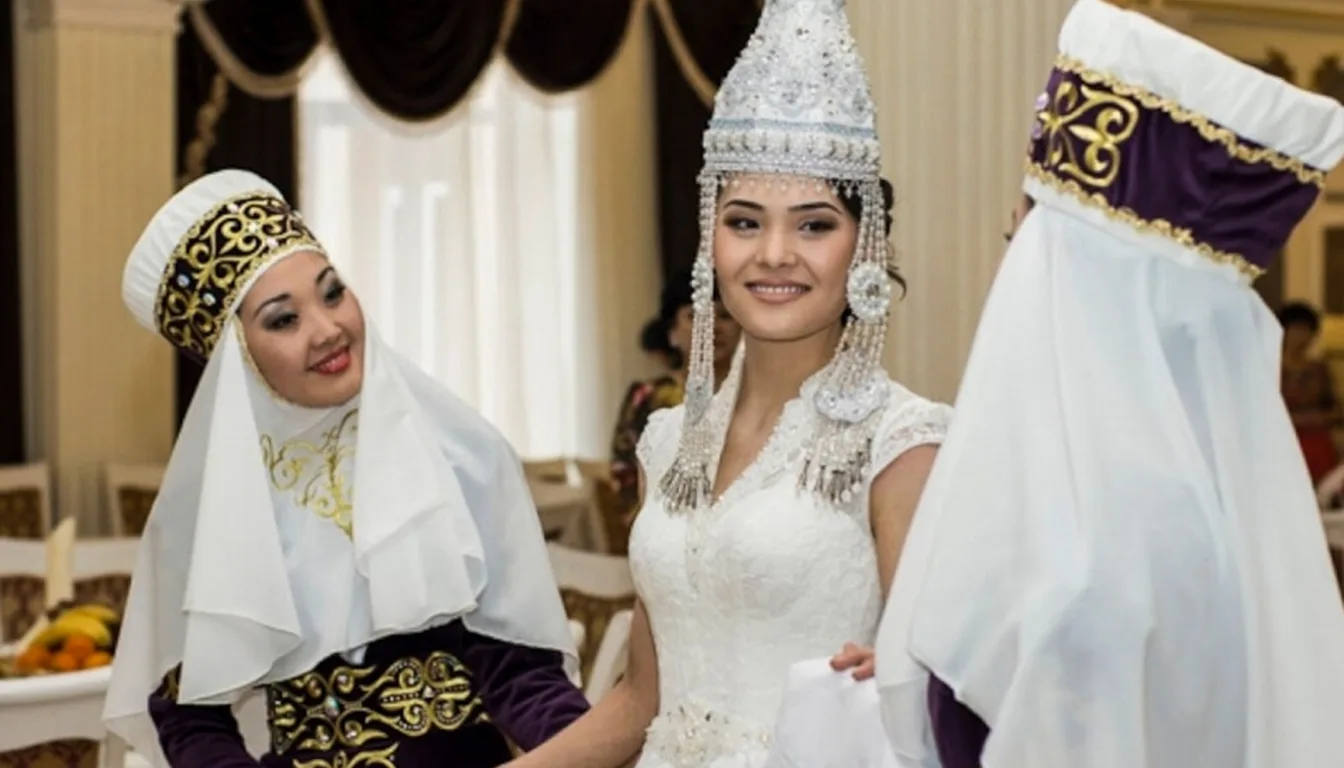
Betashar (беташар, “opening the face”) takes place at the groom’s family home. The bride arrives with her face covered by a veil, and a master of ceremonies (usually a respected singer or poet) performs a song introducing the bride to each member of the groom’s family. As each relative is named, the bride bows in greeting, and the veil is gradually lifted. Family members place gifts or money on a tray as they are introduced.
Betashar is the moment the bride officially becomes part of the groom’s family. People widely regard it as one of the most meaningful Kazakh wedding customs, and modern couples continue to include it even in otherwise contemporary wedding celebrations.
Other Wedding Customs
- Kudalyk: the formal matchmaking visit where the groom’s family presents gifts to the bride’s family
- Kalym: a traditional bride price (today often symbolic or replaced by mutual gift exchange)
- Neke qiyu: the Islamic marriage ceremony conducted by an imam
Birth and Childhood Traditions
Kazakh families celebrate a child’s arrival with a series of rituals designed to protect the baby, welcome it into the community, and mark developmental milestones.
Shildehana, The Birth Celebration
Shildehana (шілдехана) is the celebration held within the first few days of a baby’s birth. Neighbors, relatives, and friends visit the family, bringing gifts for the newborn and the mother. A dastarkhan is prepared, bata is given, and the baby is formally introduced to the community. In traditional practice, the celebration often lasted until the 40th day, a period during which the mother and baby were considered especially vulnerable and were protected from outside visitors.
Besik Toi, Placing in the Cradle
Besik toi (бесік той) marks the ceremony of placing the baby into a traditional wooden cradle called a besik. The cradle is prepared by the baby’s maternal grandmother, who decorates it with protective charms and wraps it in clean white cloth. This ceremony typically takes place on the 3rd to 7th day after birth.
Tusau Kesu, Cutting the Cord
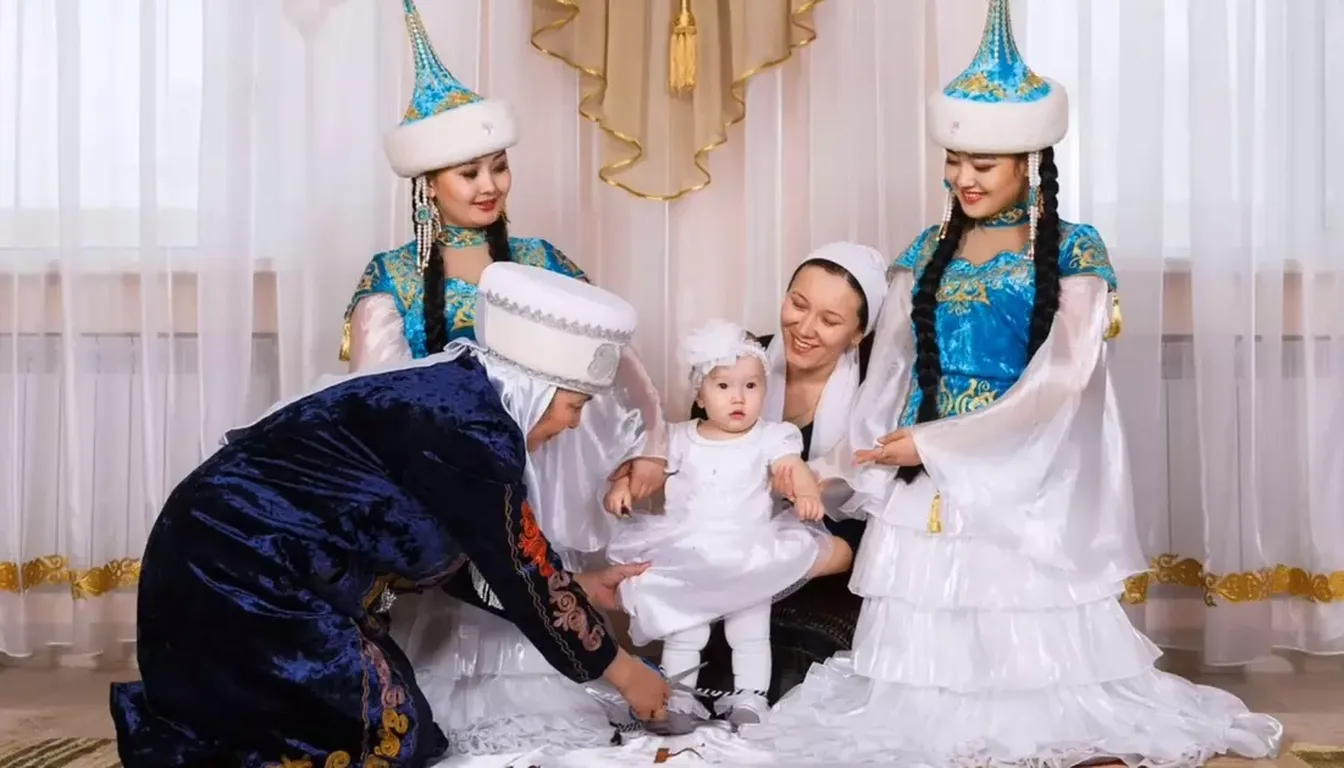
Tusau kesu (тұсау кесу, “cutting the hobbles”) is one of the most distinctive Kazakh traditions. According to Wikipedia’s documentation of Kazakh customs, when a toddler takes their first steps (usually between 10 and 14 months), a ceremony is held where the child’s legs are loosely bound with a multicolored string (ala zhip). A respected elder or a person with qualities the family admires (such as strength, intelligence, or kindness) is chosen to cut the string with a knife, symbolically freeing the child to walk through life with those same qualities.
The event is celebrated with a feast, and the child walks between two rows of guests who toss sweets and coins at their feet. Tusau kesu remains one of the most widely practiced Kazakhstan traditions, observed in both rural and urban families across the country.
Funeral and Memorial Traditions
Death traditions in Kazakhstan blend pre-Islamic Turkic practices with Islamic funeral rites. The body is washed and wrapped in white cloth (kafan) according to Islamic tradition and buried as quickly as possible, usually within 24 hours.
What distinguishes Kazakh funeral customs is the extended mourning and memorial cycle:
- Zheti: a memorial gathering on the 7th day after death
- Qyrqy: a memorial on the 40th day, considered the moment the soul fully departs
- Zhyldyk (as): a one-year memorial feast, the largest and most important, which can involve slaughtering a horse and feeding the entire village or community
- Zhoqtau: a traditional lamentation sung by women expressing grief and honoring the deceased
The one-year memorial (as) is a major social event. Families save for months to host it, and hundreds of guests may attend. It is both a duty to the deceased and a demonstration of the family’s standing in the community.
Nauryz: The Spring Equinox Celebration
Nauryz (Наурыз, March 22) is the biggest national holiday in Kazakhstan and the clearest expression of Kazakh identity. It marks the spring equinox, the start of the new year in the ancient Turkic calendar, and the renewal of nature after the harsh Central Asian winter. According to the United Nations General Assembly Resolution 64/253, Nowruz/Nauryz is celebrated by over 300,000,000 people across more than 20 countries worldwide.
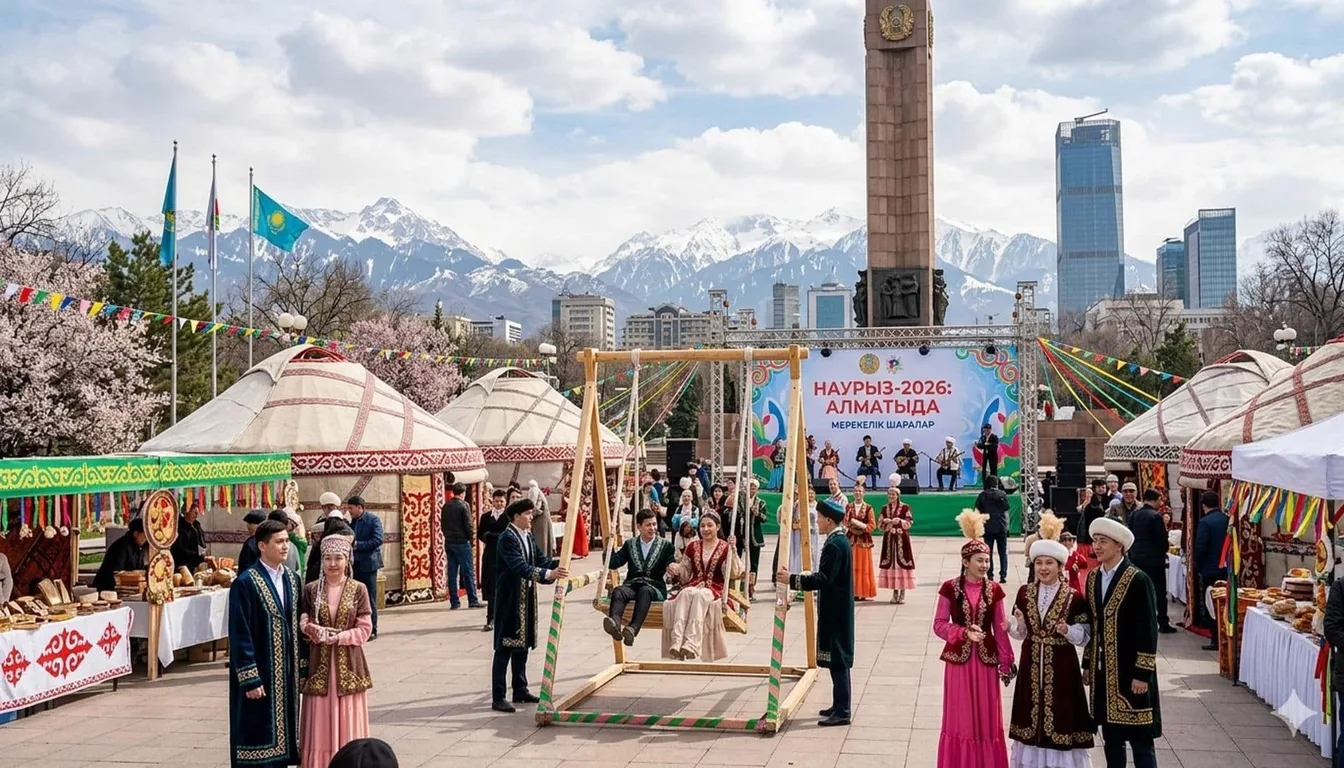
During Nauryz, cities and villages across Kazakhstan set up yurts, prepare enormous dastarkhan spreads, and organize public celebrations that include:
- Nauryz kozhe: a special soup made from seven ingredients (water, meat, salt, butter, flour, grain, and milk), symbolizing abundance and the seven days of the week
- Horse games: kokpar, baiga, and kyz kuu (described below)
- Aitys: improvised oral poetry competitions between akyns
- Traditional music and dance performances
- Yurt-building demonstrations
- Altybaskan: a traditional swing for girls
- Public feasts where food is shared freely
Nauryz was banned during the Soviet period and officially restored in 1988. According to Wikipedia’s overview of Nauryz, since 2001 it has been a three-day public holiday (March 21-23). For a deeper dive, read our full guide on Nauryz in Kazakhstan.
Eagle Hunting (Berkutchi Tradition)
Eagle hunting (berkutchi or qusbegi) is one of the most ancient and visually dramatic Kazakhstan traditions. Kazakh hunters in the Altai Mountains of western Mongolia and eastern Kazakhstan have trained golden eagles (berkut) to hunt foxes, rabbits, and even wolves for at least 2,000 years. According to UNESCO’s Intangible Cultural Heritage records, there are approximately 250 active eagle hunters (berkutchi) in Kazakhstan today, and the art of falconry is now recognized by 25 countries, reflecting its cross-cultural significance.
The tradition involves:
- Capturing and training a young female golden eagle (females are larger and more powerful)
- Bonding with the eagle over months of daily handling, feeding, and trust-building
- Hunting on horseback across the snow-covered steppe and mountain terrain during winter
- Releasing the eagle back into the wild after 5-7 years to breed
The Golden Eagle Festival in Bayan-Ulgii, Mongolia (near the Kazakhstan border) draws international attention every October, but eagle hunting is practiced year-round by Kazakh berkutchi in both countries. UNESCO inscribed falconry, including Kazakh eagle hunting, on its Intangible Cultural Heritage list in 2010.
For the full story, see our dedicated guide on eagle hunting in Kazakhstan.
Horse Games: Kokpar, Kyz Kuu, and Baiga
Horses are central to Kazakh identity. The Kazakh word for wealth, “baylyk,” is etymologically tied to livestock, and horses were the most prized animals on the steppe. Based on Bureau of National Statistics of Kazakhstan livestock data, Kazakhstan has approximately 3,700,000 horses, the largest horse population in Central Asia and among the top 10 globally, with over 60% of horses kept in rural auls (villages) for traditional purposes including horse games, kumis production, and meat. Traditional horse games remain popular across Kazakhstan and are staged at every major celebration, especially Nauryz.
Kokpar (Buzkashi)
Kokpar (көкпар) is a mounted team sport where riders compete to grab a goat carcass and carry it to a scoring zone. It is fast, physically demanding, and sometimes dangerous. Kazakhstan has a professional kokpar league, and the sport draws large crowds at national tournaments.
Kyz Kuu, Chase the Girl
Kyz kuu (қыз қуу, “chase the girl”) is a horse race between a man and a woman. The woman rides ahead, and the man must catch and kiss her before a set finish line. If he fails, the woman chases him back and is allowed to whip him. The game is rooted in courtship traditions and remains a crowd favorite at festivals.
Baiga, Long-Distance Racing
Baiga (бәйге) is a long-distance horse race, typically 25 to 50 kilometers across open steppe. Riders are often children (for lighter weight), and the horses are specially bred and trained. Baiga is one of the oldest equestrian traditions in Central Asia.
Tenge Ilu, Coin Pickup
Tenge ilu (теңге алу) requires a rider at full gallop to pick up a coin or object from the ground. It tests horsemanship, flexibility, and bravery, and has roots in battlefield skills.
Music Traditions: Dombra and Kui
Music is one of the most important carriers of Kazakh cultural memory. The dombra (домбыра), a two-stringed long-necked lute, is the national instrument of Kazakhstan and probably the most recognizable symbol of Kazakh artistic tradition. According to UNESCO’s documentation of the dombra tradition, inscribed in 2014, the instrument is played by hundreds of thousands of Kazakhs, with dombra instruction mandatory in more than 3,000 schools and approximately 700,000 students studying it as part of their curriculum each year.
The Dombra
Nearly every traditional Kazakh household owned a dombra. It was used to:
- Accompany singing and storytelling
- Perform kui (кюй), instrumental compositions that tell stories without words
- Provide music at celebrations, funerals, and everyday gatherings
The most famous kui compositions have names and narratives. “Aksak Kulan” tells the story of Genghis Khan’s son being killed during a wild horse hunt. “Adai” is an energetic piece associated with the Adai tribe of western Kazakhstan. These pieces are part of the national school curriculum, and dombra instruction is mandatory in many Kazakh schools.
Kui, Musical Storytelling
Kui are instrumental pieces performed on dombra (or sometimes kobyz, an ancient bowed instrument) that convey entire stories, emotions, and historical events through melody and rhythm alone, without lyrics. A skilled dombra player can make an audience laugh, cry, or feel the thunder of hooves through purely instrumental performance. UNESCO recognized the tradition of playing kui on the dombra as Intangible Cultural Heritage in 2014.
Oral Storytelling: Zhyrau, Akyns, and Aitys
Before written literature, Kazakh culture was transmitted orally through professional storytellers and poet-musicians. This tradition remains alive in Kazakhstan today.
Zhyrau, Epic Storytellers
Zhyrau (жырау) were sage-poets who recited epic narratives (zhyr) about heroes, battles, and the origins of the Kazakh people. The most famous epics include “Koblandy Batyr”, “Er Targyn”, and “Alpamys”. Zhyrau held high social status and served as advisors to khans. Their recitations could last for hours or even days.
Akyns, Improvising Poets
Akyns (ақын) are poet-musicians who compose and perform songs spontaneously. Unlike zhyrau who recite memorized epics, akyns create new verses on the spot, commenting on current events, praising (or mocking) public figures, and responding to audience requests.
Aitys, The Poetry Battle
Aitys (айтыс) is a competitive improvised poetry duel between two akyns, performed in front of a live audience with dombra accompaniment. Each akyn takes turns singing verses that attack the opponent’s argument, praise their own region or values, and demonstrate superior wit and musical skill. Aitys competitions draw thousands of spectators, are broadcast on national television, and carry significant prize money. The tradition has been practiced continuously for centuries and shows no signs of declining.
Food Traditions and Eating Etiquette
Kazakh food traditions are inseparable from hospitality customs. How food is prepared, served, and eaten carries social meaning. For a full overview of Kazakh cuisine, see our guide to popular food in Kazakhstan.
Beshbarmak Etiquette
Beshbarmak (бешбармақ, “five fingers”) is the national dish: boiled meat (usually horse or lamb) served over flat noodles. The name refers to the traditional way of eating: with all five fingers, without utensils. Key etiquette rules:
- The eldest man or host carves and distributes the meat
- The sheep’s head is served to the guest of honor, who then divides it among others (each part has symbolic meaning: the ear to a child so they will listen, the tongue to a young person so they develop eloquence, the eye to the one who should see far)
- Everyone eats from a shared plate
- Tea follows immediately after the meat course
Kumis and Shubat
Kumis (қымыз), fermented mare’s milk, is the national drink. It is mildly alcoholic (1-3%), slightly sour, and produced only during the warm months when mares are lactating (roughly May through September). Shubat (шұбат) is fermented camel’s milk, thicker and more sour, popular in western and southern Kazakhstan. Both drinks are considered medicinal and are offered to guests as a sign of high respect.
Baursak, Sacred Bread
Baursak (бауырсақ), deep-fried dough balls, is present at every important gathering: weddings, funerals, Nauryz, and everyday dastarkhan. It is considered sacred in the same way bread is treated in many cultures; dropping baursak on the ground and stepping on it is considered disrespectful.
Respect for Elders
Respect for elders (ata-ana, meaning “father-mother,” or parents and all elder relatives) is not just a value in Kazakhstan. It is a strict behavioral code enforced from childhood:
- Greeting: Younger people always greet elders first, standing up when an elder enters the room
- Seating: Elders sit at the tor (place of honor, farthest from the door)
- Serving: Elders are served tea and food first
- Speaking: Younger people do not interrupt elders or argue openly with them
- Decision-making: Important family decisions (marriages, property, disputes) involve elder consultation
- Naming: It is considered inappropriate to address elders by their first name alone; honorifics like “aga” (elder brother), “apa” (elder sister/aunt), or “ata/azhe” (grandfather/grandmother) are always used
This system of deference is one reason why extended family networks remain strong in Kazakhstan even as urbanization accelerates. Young Kazakhs who live in Almaty or Astana still travel to their home regions for major holidays and family events, and elder relatives continue to exercise significant influence over life decisions.
Gift-Giving Customs
Gift-giving in Kazakhstan is a structured social practice, not a casual gesture. The most important customs include:
Chapan Kigizu
Presenting a chapan (traditional robe) to an honored guest is one of the highest forms of recognition. It signals deep respect and gratitude. For more on traditional garments, see our guide on Kazakhstan traditional clothing.
Suyunshi
Suyunshi (сүйінші) is a reward given to the person who brings good news, such as the birth of a child, a wedding engagement, or a successful journey. The bearer of good news can approach the family and say “Suyunshi!” to claim a gift or payment. This tradition encourages the rapid spread of positive news through the community.
Korimlik
Korimlik (көрімдік) is a gift given when seeing a bride, newborn baby, or new home for the first time. The amount is flexible, but failing to give korimlik when expected is noticed and remembered.
At Mingizu
At mingizu (ат мінгізу), literally “to seat on a horse,” is the gift of a horse to an especially honored guest. In nomadic times, this was the most generous gift possible. Today it is rare but still practiced in rural areas for extraordinary occasions.
Traditions Overview Table
| Tradition | Category | When Practiced | Still Active? |
|---|---|---|---|
| Dastarkhan | Hospitality | Every guest visit | Yes, daily |
| Bata (blessing) | Hospitality | After meals and events | Yes, daily |
| Kyz uzatu | Wedding | Before bride leaves | Yes, most weddings |
| Betashar | Wedding | At groom’s home | Yes, most weddings |
| Shildehana | Birth | First days after birth | Yes, widely |
| Tusau kesu | Childhood | First steps (~1 year) | Yes, universally |
| As (memorial) | Funeral | One year after death | Yes, universally |
| Nauryz | Holiday | March 21-23 | Yes, national holiday |
| Eagle hunting | Hunting | Winter months | Yes, western KZ |
| Kokpar | Horse games | Festivals, Nauryz | Yes, professional league |
| Aitys | Oral poetry | Competitions, TV | Yes, growing popularity |
| Dombra/Kui | Music | All occasions | Yes, school curriculum |
| Beshbarmak serving | Food | Formal meals | Yes, daily |
| Chapan kigizu | Gift-giving | Honored guests | Yes, ceremonies |
| Respect for elders | Social code | All interactions | Yes, daily |
Frequently Asked Questions
- What is the most important tradition in Kazakhstan?
- Hospitality (konaqzhailyk) is considered the most important tradition in Kazakhstan. Welcoming guests with tea and a full dastarkhan is a core social obligation rooted in nomadic survival, on the steppe, refusing shelter to a traveler could mean death. Today this custom applies to all visitors, expected or unexpected.
- What is tusau kesu in Kazakhstan?
- Tusau kesu ("cutting the hobbles") is a ceremony held when a child takes their first steps, typically around 10-14 months old. The child's legs are loosely bound with a multicolored string, and a respected person cuts it, symbolically freeing the child to walk through life with good qualities. It is celebrated with a feast.
- What happens during a traditional Kazakh wedding?
- A traditional Kazakh wedding involves multiple stages: kudalyk (matchmaking), kyz uzatu (farewell ceremony at the bride's home with singing and blessings), the bride's journey to the groom's family, and betashar (the unveiling ceremony where the bride is formally introduced to the groom's relatives). Modern weddings often combine these with a restaurant reception.
- Is Nauryz a religious holiday in Kazakhstan?
- No. Nauryz is a secular spring equinox celebration rooted in ancient Turkic and Zoroastrian traditions, not Islam. It marks the start of the new year in the traditional calendar (March 22) and is celebrated by all ethnic groups in Kazakhstan with communal feasts, horse games, music, and yurt displays.
- What is aitys in Kazakh culture?
- Aitys is a competitive improvised poetry duel between two akyns (poet-musicians), performed with dombra accompaniment before a live audience. Each poet takes turns singing spontaneous verses to outdo the other in wit, musical skill, and rhetorical power. Aitys competitions are broadcast on national television and remain one of the most popular cultural events in Kazakhstan.
- Do Kazakh traditions still exist in modern cities?
- Yes. Even in Almaty and Astana, traditions like dastarkhan hospitality, respect for elders, tusau kesu, betashar at weddings, and Nauryz celebrations are widely practiced. Urbanization has changed some forms (restaurant weddings instead of yurt ceremonies), but the underlying social customs remain strong across all generations.
Last verified: March 2026
More Stories
culture
Kazakhstan Wedding Traditions: Customs, Rituals, and Meaning
Complete guide to Kazakhstan wedding traditions — betashar, kyz uzatu, saukele, neke qiyu, modern costs, food, gift-giving, and what guests should know.
culture
Nauryz in Kazakhstan
Nauryz in Kazakhstan: the 3,000-year-old spring New Year celebrated every March 22. Nauryz kozhe, horse games, yurt festivals, and 2026 event calendar.

facts
Cost of Living in Kazakhstan 2026: Almaty From $1,200/Month
Real 2026 prices: Almaty rent $400-800, dinner $5-8, metro $0.30. Monthly budget $690-1,500. 65% cheaper than New York. City-by-city comparison tables.