Is Kazakhstan in Russia? No — Here's the Full Explanation
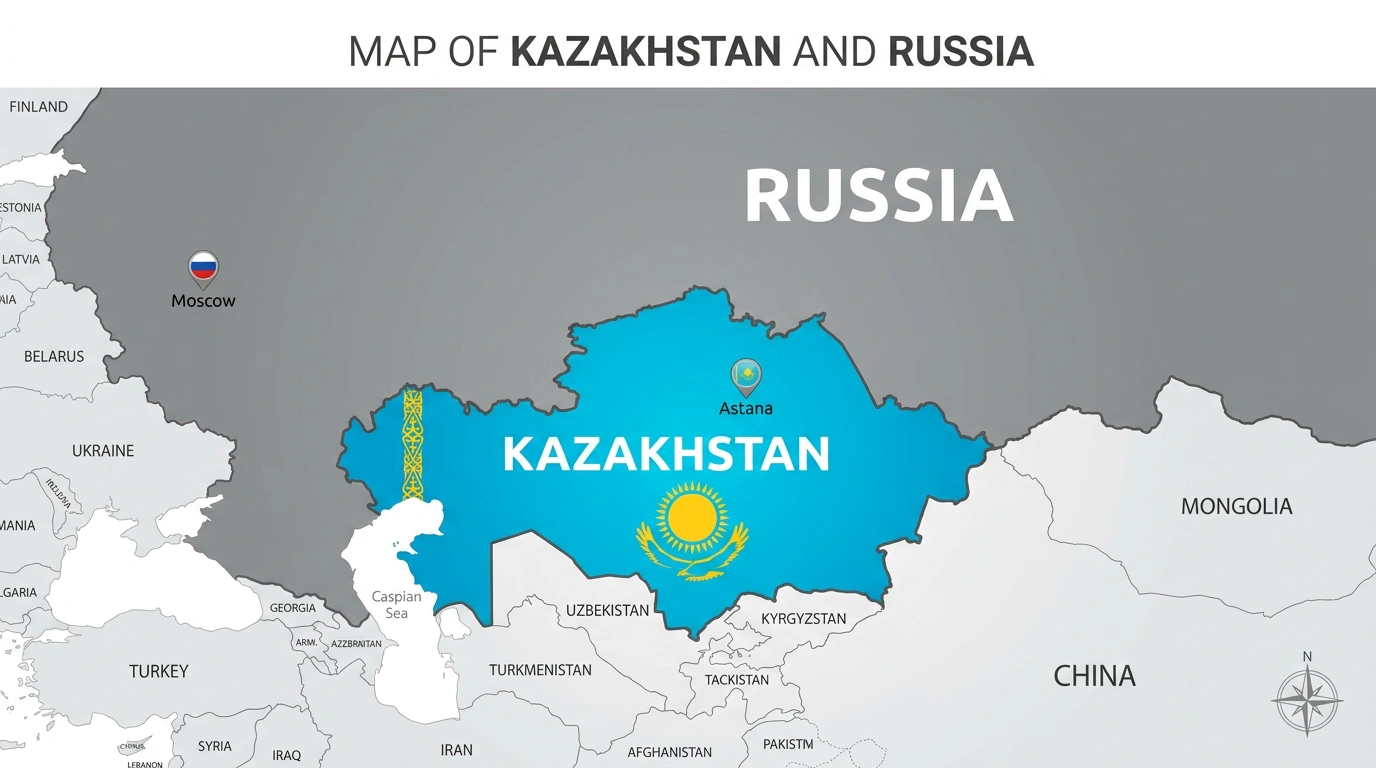
No, Kazakhstan is not in Russia. Kazakhstan is an independent country and the largest nation in Central Asia. It has been a fully sovereign state since December 16, 1991, when the Soviet Union collapsed. Kazakhstan has its own government, president, military, currency (the tenge), constitution, and foreign policy, completely separate from Russia. The confusion is understandable because Kazakhstan was part of the Soviet Union for 70 years and shares the world’s longest continuous land border with Russia (7,644 km). But these are two entirely different countries, just as Canada and the United States are different countries that share a border.
Kazakhstan vs Russia: Key Differences at a Glance
The simplest way to understand that Kazakhstan is not Russia is to compare them side by side. Here is a comprehensive comparison table:
| Category | Kazakhstan | Russia |
|---|---|---|
| Status | Independent sovereign state | Independent sovereign state |
| Independence | December 16, 1991 | Successor state of the USSR |
| Capital | Astana | Moscow |
| Head of State | President Kassym-Jomart Tokayev | President Vladimir Putin |
| Currency | Tenge (KZT) | Ruble (RUB) |
| Area | 2,724,900 km² (9th in world) | 17,098,242 km² (1st in world) |
| Population | 20.5 million (2026) | 144 million (UN, 2024) |
| State Language | Kazakh (Turkic family) | Russian (Slavic family) |
| Major Religion | Islam (70% Sunni Muslim) | Orthodox Christianity (70%) |
| Ethnic Majority | Kazakhs (70.4%) | Russians (77.7%) |
| Cultural Roots | Turkic nomadic heritage | Slavic-European heritage |
| UN Member Since | 1992 | 1945 (as USSR successor) |
| GDP per Capita | $13,190 (World Bank, 2024) | $12,575 (World Bank, 2024) |
| Government Type | Presidential republic | Federal semi-presidential republic |
| Continent | Asia (small part in Europe) | Europe and Asia |
| Passport | Kazakh passport | Russian passport |
| Visa Policy | Independent (72 visa-free countries) | Independent |
| Calling Code | +7 (shared historically) | +7 |
These two countries have different languages, different religions, different ethnic compositions, different cultures, and different governments. They simply happen to share a very long border, and 70 years of shared Soviet history.
Why Do People Think Kazakhstan Is Part of Russia?
The question “is Kazakhstan in Russia?” is searched hundreds of times every month, and the confusion has clear historical and cultural roots. Here are the main reasons people mix up the two countries.
The Soviet Union (1920–1991)
Kazakhstan was a Soviet Socialist Republic (the Kazakh SSR) within the USSR from 1920 to 1991. During this 70-year period, all major decisions about Kazakhstan’s economy, language, industry, education, and borders were made in Moscow by the Soviet central government. Kazakhstan did not have independent foreign policy, could not issue its own currency, and was economically integrated into the Soviet system.
During the Soviet era, millions of Russians and other Slavic peoples were resettled in Kazakhstan. Stalin’s collectivization campaigns in the 1930s devastated the Kazakh nomadic population (an estimated 1.5 million Kazakhs died in the resulting famine), and Khrushchev’s Virgin Lands campaign (1954–1963) brought hundreds of thousands of Russian and Ukrainian settlers to northern Kazakhstan to farm the steppe. By 1959, ethnic Kazakhs were actually a minority in their own country, making up only 30% of the population (Soviet Census, 1959).
This history means that for anyone born before 1991, and for many history books published before that date, Kazakhstan was effectively governed as part of the same political entity as Russia. But that entity was the Soviet Union, not Russia, and it dissolved over three decades ago.
The Russian Language
Russian remains widely spoken in Kazakhstan, which adds to the confusion. In northern cities like Astana and Petropavlovsk, Russian is the primary language of daily communication for many residents. In business, government administration, and higher education, Russian is commonly used alongside Kazakh.
Kazakhstan’s constitution designates Kazakh as the “state language” and Russian as the language of “inter-ethnic communication.” This means government documents are issued in both languages, most Kazakhstanis are bilingual, and visitors who speak Russian can communicate easily throughout the country. For travelers, this creates the impression that Kazakhstan is “part of Russia,” but the same logic would make Brazil part of Portugal or the United States part of England.
Cultural Overlap from the Soviet Era
Seventy years of Soviet governance created visible cultural overlap between all post-Soviet countries, not just Kazakhstan and Russia. Soviet-era apartment blocks (khrushchyovki) look identical in Almaty and Moscow. Some Soviet-era holidays are still observed in both countries. Soviet films, music, and literature remain part of the cultural landscape in Kazakhstan, in the same way that British colonial influence remains visible in India without making India part of Britain.
Geographic Proximity and Map Confusion
On many simplified world maps, especially those that do not use distinct colors for Central Asian countries, Kazakhstan appears as part of the same landmass as Russia without a clearly visible border. The two countries are adjacent, and Kazakhstan is sometimes categorized under “Russia and neighboring countries” in textbooks and travel guides, which reinforces the misconception.
The Borat Effect
Sacha Baron Cohen’s 2006 film Borat and its 2020 sequel introduced millions of viewers to the name “Kazakhstan” for the first time. However, the films are satirical fiction (filmed in Romania and the United States), and many viewers had no frame of reference to distinguish Kazakhstan from Russia. The films arguably increased global awareness of Kazakhstan’s existence while simultaneously distorting perceptions of it.
History: How Russia Colonized Kazakhstan
The relationship between Kazakhstan and Russia stretches back centuries. Understanding this history explains why the confusion exists and why independence was such a significant achievement.
Russian Empire Colonization (1731–1917)
The Kazakh Khanate, which had existed since 1465 as an independent Turkic state, began seeking Russian protection in the 1730s to defend against Dzungar invasions from the east. According to Britannica’s entry on the Kazakh Khanate, the Khanate at its peak under Kasym Khan (1511-1521) controlled territory from the Ural River to the Altai Mountains and governed approximately one million people. Starting in 1731, the three Kazakh tribal confederations (zhuz) gradually accepted Russian suzerainty, though the terms were often coerced rather than voluntary.
By the mid-19th century, Russia had consolidated full colonial control over Kazakhstan. Russian forts became cities (Verny, now Almaty; Akmolinsk, now Astana). Cossack settlers took Kazakh pasturelands. The 1916 Central Asian revolt against Russian conscription was brutally suppressed, killing tens of thousands of Kazakhs and forcing hundreds of thousands to flee to China.
The Soviet Period (1920–1991)
After the Russian Revolution, Kazakhstan became the Kyrgyz Autonomous Socialist Soviet Republic in 1920 (the name was corrected to Kazakh in 1925), and a full Soviet Socialist Republic in 1936. The Soviet era brought:
- Collectivization famine (1931–1933): An estimated 1.5 million Kazakhs, roughly 40% of the Kazakh population, died as Soviet policies destroyed the nomadic pastoral economy (Pianciola, 2001; Cameron, 2018)
- Nuclear testing at Semipalatinsk: According to the Comprehensive Nuclear-Test-Ban Treaty Organization (CTBTO), the Soviet Union conducted 456 nuclear tests in northeastern Kazakhstan between 1949 and 1989, devastating the health of local populations
- Virgin Lands campaign (1954–1963): Massive agricultural settlement program that brought 300,000+ Slavic settlers and transformed northern Kazakhstan
- Language suppression: Kazakh-language education was systematically reduced; by the 1980s, most urban Kazakhs were Russian-dominant speakers
Independence (1991)
Kazakhstan declared independence on December 16, 1991, the last Soviet republic to do so. Nursultan Nazarbayev, who had been the Communist Party leader of the Kazakh SSR, became the first president. According to the Nuclear Threat Initiative (NTI), the country inherited the world’s fourth-largest nuclear arsenal from the Soviet Union and voluntarily gave it up in 1993–1995 under the Lisbon Protocol and Budapest Memorandum, one of the most significant acts of nuclear disarmament in modern history.
Since 1991, Kazakhstan has built entirely independent state institutions: its own military, its own central bank (National Bank of Kazakhstan), its own currency (introduced in 1993), its own constitution (1995), and its own diplomatic relationships with over 180 countries.
The Shared Border: 7,644 Kilometers
Kazakhstan and Russia share a 7,644 km land border, the longest continuous land border in the world and the second-longest international border overall (after the Canada-US border at 8,891 km including the Great Lakes). This border stretches from the Caspian Sea in the west to the Altai Mountains in the east, crossing steppe, desert, and agricultural regions.
The border was demarcated during the Soviet period as an internal administrative boundary between two Soviet republics. When both countries became independent in 1991, this administrative line became an international border. Formal demarcation was completed through bilateral agreements in 2005.
Major border crossing points include:
- Petropavlovsk–Ishim (north-central): Between the Kazakh city of Petropavlovsk and Russia’s Tyumen Oblast
- Oral–Orenburg: Between western Kazakhstan and Russia’s Orenburg Oblast
- Semey–Rubtsovsk: Between eastern Kazakhstan and Russia’s Altai Krai
The long shared border means that northern Kazakh cities like Petropavlovsk, Kostanay, and Oral are geographically closer to Russian cities than to Kazakhstan’s own capitals of Astana or Almaty. This geographic reality contributes to the cultural and linguistic Russian influence in northern Kazakhstan, but it does not make these areas part of Russia.
The Russian Minority in Kazakhstan
Approximately 15.2% of Kazakhstan’s population is ethnic Russian, according to the 2021 national census, down from 37.4% in 1989 (Soviet Census) and 29.9% in 1999. This significant decline is due to emigration of ethnic Russians to Russia (especially in the 1990s) and higher birth rates among ethnic Kazakhs.
The Russian minority is concentrated in northern Kazakhstan:
- North Kazakhstan Region: ~30% ethnic Russian
- Kostanay Region: ~25% ethnic Russian
- Pavlodar Region: ~22% ethnic Russian
- Karaganda Region: ~17% ethnic Russian
Ethnic Russians in Kazakhstan have full citizenship rights, and Russian is used in government services alongside Kazakh. However, the demographic trend is clear: Kazakhstan is becoming more ethnically Kazakh and more Kazakh-speaking with each decade. The government has promoted Kazakh-language education, renamed cities and streets from Russian to Kazakh names, and planned a transition from Cyrillic to Latin script for the Kazakh language (though the timeline has been extended multiple times).
There is no active separatist movement among Kazakhstan’s Russian minority, unlike in some other post-Soviet states. Relations between ethnic Kazakhs and ethnic Russians within Kazakhstan are generally peaceful.
Current Kazakhstan-Russia Relations
Kazakhstan and Russia maintain significant economic, security, and cultural ties, but Kazakhstan has increasingly asserted an independent foreign policy, especially since 2022.
Economic Ties
Russia is one of Kazakhstan’s top trading partners. Both countries are members of the Eurasian Economic Union (EAEU), a free trade zone that also includes Belarus, Armenia, and Kyrgyzstan. According to Eurasian Economic Union (EAEU) official statistics, trade between Kazakhstan and Russia totaled approximately $26 billion in 2023. Russian companies have significant investments in Kazakhstan, and Kazakh oil transits through Russian pipelines. According to Kazakhstan’s Ministry of Energy, the CPC pipeline to Novorossiysk carries about two-thirds of Kazakh oil exports.
However, Kazakhstan has actively diversified its economic relationships. China has become a major trade and investment partner through the Belt and Road Initiative. The EU is Kazakhstan’s largest export market for oil. Turkey, South Korea, and the United States are significant investors. Kazakhstan’s economic sovereignty is reinforced by its independent central bank, independent currency, and independent trade agreements.
Security Cooperation
Kazakhstan is a member of the Collective Security Treaty Organization (CSTO), a Russia-led military alliance. In January 2022, CSTO forces (primarily Russian troops) were deployed to Kazakhstan at President Tokayev’s request during the Bloody January unrest. The troops were withdrawn within two weeks.
Despite CSTO membership, Kazakhstan has refused to participate in Russia’s military operations. Kazakhstan did not send troops to support Russia in Ukraine and has publicly stated it will not do so.
Divergence Since 2022
Russia’s invasion of Ukraine in February 2022 marked a turning point in Kazakhstan-Russia relations. President Tokayev has:
- Refused to recognize Russia’s annexation of Crimea, Donetsk, Luhansk, Zaporizhzhia, and Kherson
- Refused to help Russia evade Western sanctions
- Welcomed Russian draft-evaders fleeing to Kazakhstan (an estimated 200,000+ arrived in 2022)
- Expanded ties with Turkey, China, the EU, and the US as counterbalances to Russian influence
- Publicly stated at the St. Petersburg Economic Forum (in Putin’s presence) that Kazakhstan does not recognize “quasi-state territories”
Kazakhstan walks a careful diplomatic line, maintaining economic ties with Russia while signaling to the West that it is not a Russian proxy state. This balancing act reflects Kazakhstan’s geographic reality: sandwiched between Russia and China, it cannot afford to alienate either neighbor.
Kazakhstan’s Own Identity: Not Russian, Not Chinese
Perhaps the most important answer to “is Kazakhstan in Russia?” goes beyond politics and borders. Kazakhstan has a distinct national identity that is fundamentally different from Russia.
Turkic Roots
Kazakhs are a Turkic people. The Kazakh language belongs to the Kipchak branch of the Turkic language family, closely related to Kyrgyz and Karakalpak. This makes Kazakh linguistically closer to Turkish and Uzbek than to Russian. Kazakhstan is an active member of the Organization of Turkic States (with Turkey, Azerbaijan, Uzbekistan, and Kyrgyzstan) and has invested heavily in promoting its Turkic identity since independence.
Nomadic Heritage
For centuries before Russian colonization, the Kazakh people were pastoral nomads who migrated across the vast Central Asian steppe with their herds of horses, sheep, and camels. This nomadic heritage defines Kazakh culture in ways that have no Russian equivalent:
- The yurt (kiyiz uy): The traditional felt tent remains a powerful cultural symbol and is featured on Kazakhstan’s state emblem
- Horsemanship: Horse culture is central to Kazakh identity, kumis (fermented mare’s milk) is the national drink, and traditional horse games like kokpar and bayga are still practiced
- Oral poetry and music: The Kazakh tradition of akyns (improvising oral poets) and dombra music is distinctly Central Asian
- Hospitality customs: The Kazakh tradition of dastarkhan (the spread table) follows nomadic hospitality codes, not Russian dining customs
Islam
Approximately 70% of Kazakhstanis identify as Muslim (primarily Sunni Hanafi), compared to Russia’s predominantly Orthodox Christian population. While Kazakhstan practices a moderate, secular form of Islam, mosques are a central feature of Kazakh cities, Ramadan is observed, and Islamic traditions shape life events (birth, marriage, death). The grand Hazrat Sultan Mosque in Astana and the Central Mosque in Almaty are among the largest in Central Asia. For a deeper look at this topic, see our guide to Kazakhstan religion.
Modern National Identity
Since independence, Kazakhstan has built a modern national identity through:
- Astana: The purpose-built capital city (moved from Almaty in 1997) with futuristic architecture by Norman Foster and others, designed to symbolize Kazakhstan’s independent future rather than its Soviet past
- EXPO 2017: Kazakhstan hosted the World Exposition in Astana, the first Central Asian country to do so
- Space heritage: The Baikonur Cosmodrome, located in Kazakhstan and leased to Russia, launched Yuri Gagarin in 1961 and still launches crewed missions to the ISS
- Sports: According to the International Olympic Committee’s Kazakhstan national profile, Kazakhstan first competed as an independent nation at the 1994 Winter Olympics and has won numerous medals in boxing, weightlifting, wrestling, and athletics. Kazakhstan competes independently in the Olympics, FIFA World Cup qualifiers, and has produced world-champion boxers like Gennady Golovkin
Is Kazakhstan Safe to Visit?
Yes. Kazakhstan is one of the safest countries in Central Asia for tourists. According to the Institute for Economics and Peace’s Global Peace Index 2024, Kazakhstan ranks above Russia and most of its Central Asian neighbors in overall peacefulness. Violent crime targeting foreigners is rare, major cities have modern infrastructure, and tourist facilities have improved significantly in the 2010s and 2020s.
Kazakhstan is not involved in any active military conflict. The January 2022 unrest was a brief domestic event that was resolved within weeks. Travelers do not need to worry about the Russia-Ukraine conflict affecting Kazakhstan, the two countries are separated by thousands of kilometers, and Kazakhstan has no involvement in that war. According to the UN World Tourism Organization’s data on Kazakhstan, tourist arrivals have continued to grow year-on-year since 2022.
Citizens of 72 countries, including the US, UK, all EU nations, Australia, Canada, Japan, and South Korea, can enter Kazakhstan visa-free for up to 30 days. Kazakhstan has its own visa policy entirely independent from Russia.
Is Kazakhstan in Europe or Asia?
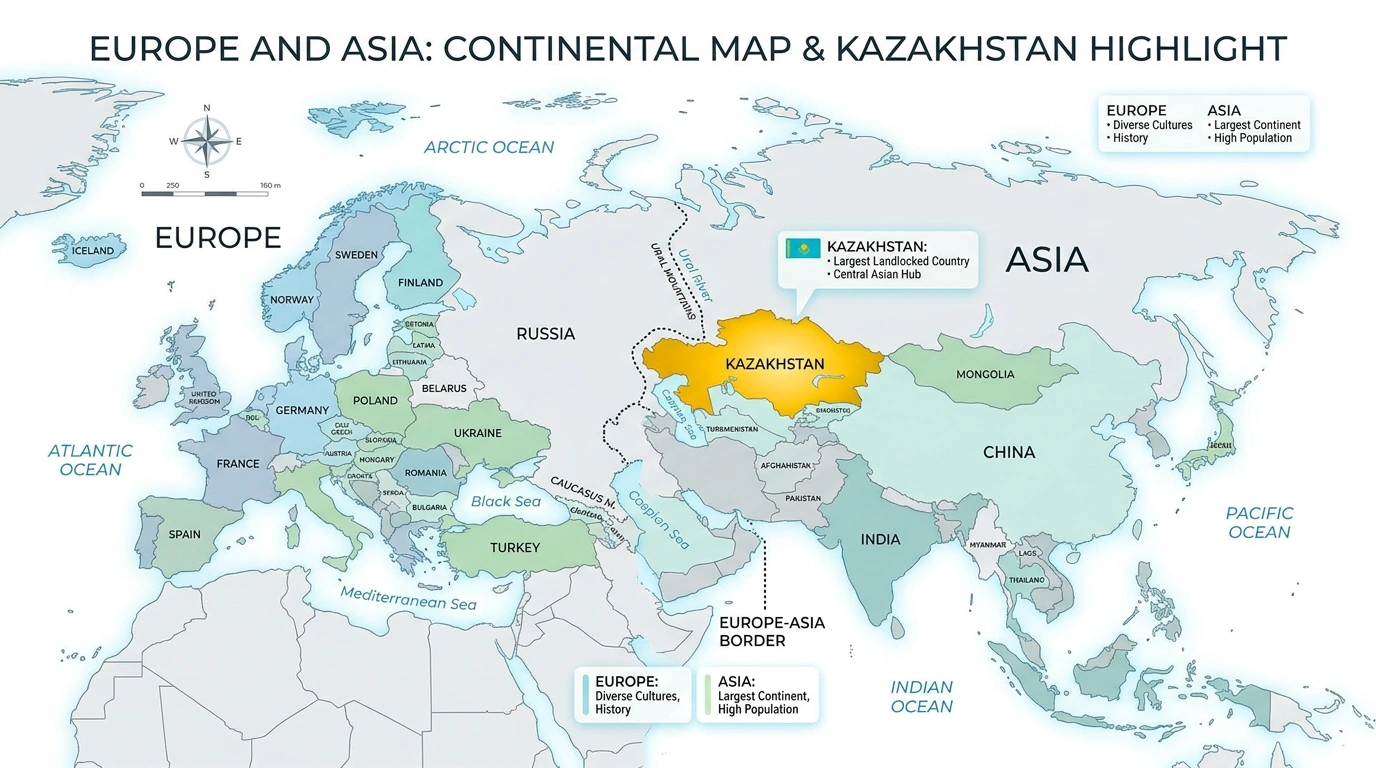
Kazakhstan is primarily in Asia, but a small western portion of the country, west of the Ural River, falls in geographic Europe. This makes Kazakhstan a transcontinental country, similar to Russia and Turkey. For a detailed breakdown, see our guide on whether Kazakhstan is in Europe.
Kazakhstan is most commonly classified as a Central Asian country, along with Uzbekistan, Kyrgyzstan, Tajikistan, and Turkmenistan. It is a member of the Central Asia regional grouping at the United Nations and in most international organizations.
Frequently Asked Questions
- Is Kazakhstan part of Russia?
- No. Kazakhstan is an independent, sovereign country that has been separate from Russia since December 16, 1991. It has its own government, president, currency (tenge), military, constitution, and foreign policy. Kazakhstan is a member of the United Nations and recognized by every country in the world as an independent state.
- Was Kazakhstan ever part of Russia?
- Kazakhstan was part of the Russian Empire from the 1730s to 1917, and then part of the Soviet Union (as the Kazakh SSR) from 1920 to 1991. It was never part of the modern Russian Federation. Since December 16, 1991, Kazakhstan has been a fully independent country.
- Do people in Kazakhstan speak Russian?
- Yes, Russian is widely spoken in Kazakhstan, especially in northern cities and in business contexts. It is constitutionally recognized as a language of inter-ethnic communication. However, Kazakh (a Turkic language unrelated to Russian) is the official state language, and its use has been expanding since independence.
- What is the difference between Kazakhstan and Russia?
- Kazakhstan and Russia differ in nearly every way: Kazakhs are a Turkic people (Russians are Slavic), Kazakhstan is majority Muslim (Russia is majority Orthodox Christian), the Kazakh language is Turkic (Russian is Slavic), and the two countries have different governments, currencies, and foreign policies. They share a border and Soviet history, but are culturally and ethnically distinct nations.
- How long is the Kazakhstan-Russia border?
- The Kazakhstan-Russia border is 7,644 km long, the longest continuous land border in the world. It stretches from the Caspian Sea in the west to the Altai Mountains in the east. Despite this long border, Kazakhstan and Russia are separate, independent countries.
- Is Kazakhstan closer to Russia or China?
- Kazakhstan shares borders with both Russia (7,644 km to the north) and China (1,783 km to the east). Geographically, more of Kazakhstan borders Russia. Culturally and ethnically, however, Kazakhs are a Turkic people with closer ties to other Central Asian and Turkic nations than to either Russia or China.
Last verified: March 2026
More Stories
facts
Is Kazakhstan in Europe or Asia? The Definitive Answer
Is Kazakhstan in Europe? No — it's in Central Asia. A tiny western sliver crosses into Europe geographically, but 95%+ of the country is in Asia.
facts
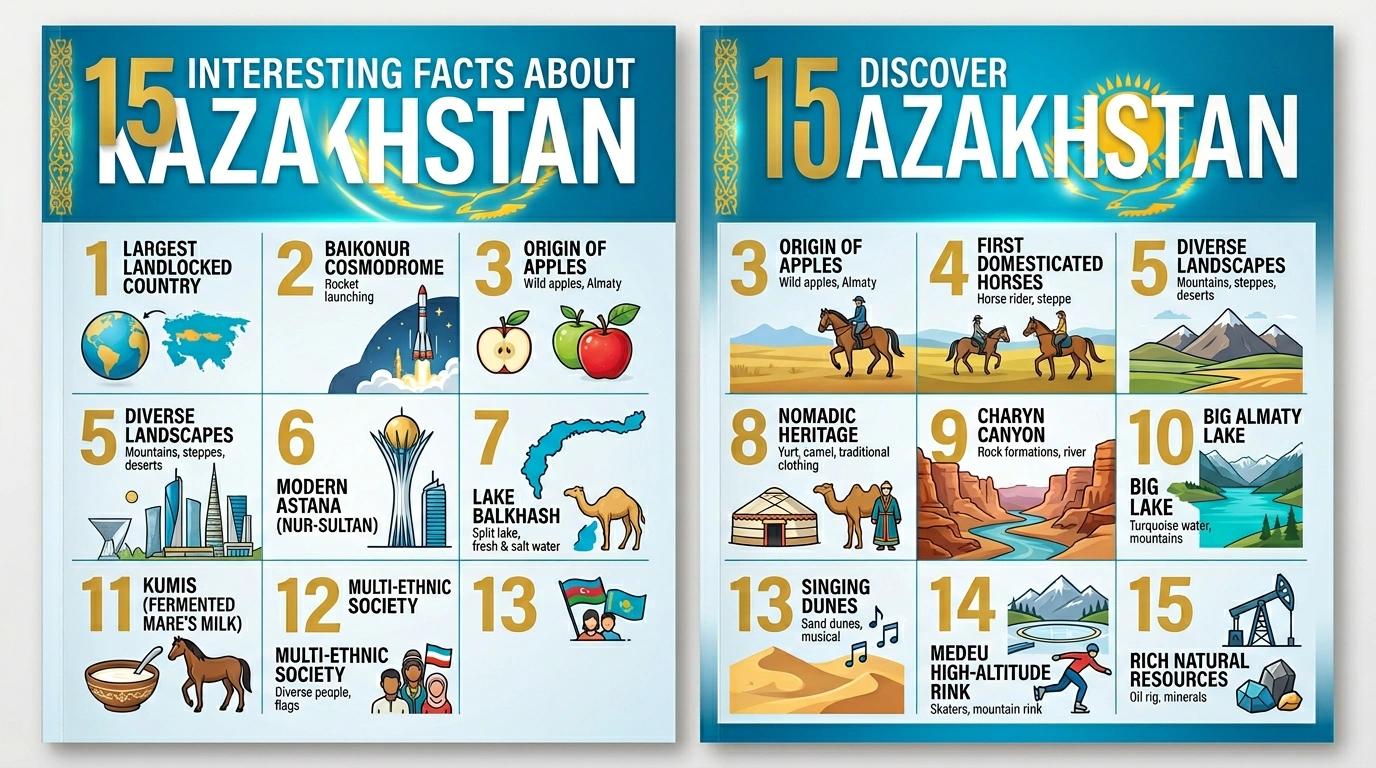
28 Facts About Kazakhstan That Surprise Everyone (2026)
Kazakhstan facts: world's 9th largest country, launched the first man in space, birthplace of apples, and 25 more truths with verified stats and sources.
facts
What Is Kazakhstan Famous For? 15 Things That Surprise Visitors
Kazakhstan is famous for Baikonur Cosmodrome, Dimash's 6-octave voice, the original apple, Borat memes, and 11 more reasons travelers visit.