Is Kazakhstan in Europe or Asia? The Definitive Answer
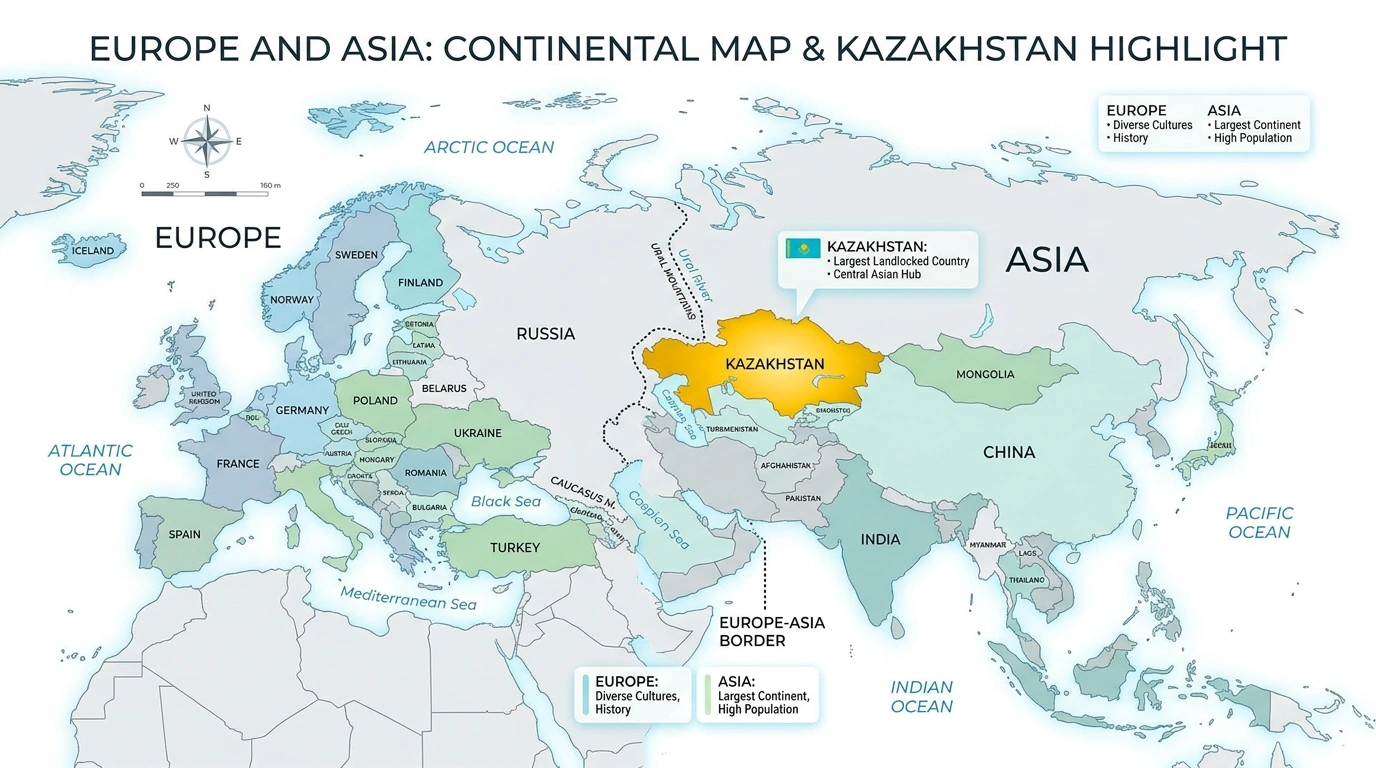
Kazakhstan is in Asia, specifically Central Asia. It is not a European country by any cultural, political, or institutional definition. According to Wikipedia’s Kazakhstan article, a small western portion of Kazakhstan (the area around Atyrau, west of the Ural River) is technically on the European side of the traditional Europe-Asia geographic boundary. Britannica’s entry on Kazakhstan confirms that over 95% of Kazakhstan’s territory and all of its major cities (Almaty, Astana, Shymkent) are firmly in Asia.
The Quick Answer
| Question | Answer |
|---|---|
| Is Kazakhstan in Asia? | Yes, primarily and officially |
| Is Kazakhstan in Europe? | No, except a tiny geographic sliver |
| Is Kazakhstan in Central Asia? | Yes, this is its standard classification |
| Is Kazakhstan in the EU? | No, not a member |
| Is Kazakhstan culturally European? | No, it is a Turkic Central Asian nation |
| Does Kazakhstan compete in European sports? | Partially, in some federations |
Where Is the Europe-Asia Boundary?
According to the National Geographic Society, the Europe-Asia boundary is not a precise geological feature. It is a geographic convention that has shifted over centuries. Britannica’s Europe article and the UN Statistics Division geoscheme both note that the boundary follows a broadly accepted convention. The most widely accepted modern definition follows:
- Ural Mountains, running north-south through Russia
- Ural River, south of where the Ural Mountains end, continuing southwest
- Caspian Sea, where the boundary runs along its western coast
- Caucasus Mountains, defining the boundary through Georgia and Azerbaijan to the southwest
By this convention, everything east of the Ural River and east of the Caspian Sea is Asia. Kazakhstan straddles this line:
- The vast majority of Kazakhstan (roughly 95%+) is east of the Ural River → Asia
- A small western zone of Kazakhstan, including most of the Atyrau Oblast (region), sits west of the Ural River → technically Europe
The City That Straddles Two Continents
Atyrau (population ~280,000) is the clearest example. This Caspian oil city sits on both banks of the Ural River, with the east bank in Asia and the west bank in Europe. Locals joke that you can walk from Asia to Europe in five minutes across a bridge. The city even has signs at the bridge marking the continental boundary.
This makes Atyrau one of the few cities in the world that literally sits on the boundary between two continents, alongside Istanbul (Europe/Asia), Magnitogorsk (Russia, also on the Ural), and Orenburg (Russia).
Why Kazakhstan Is Classified as Asian, Not European
Despite the geographical technicality, Kazakhstan is unambiguously an Asian country by every meaningful measure:
Geography and Population
All of Kazakhstan’s major cities are in Asia:
- Almaty (roughly 2.2 million), far southeast, near the Chinese border
- Astana (1.3 million), north-center, deep in the steppe
- Shymkent (1.2 million), south, near Uzbekistan
The European portion of Kazakhstan (west of the Ural River) is a sparsely populated zone dominated by the Caspian oil industry. It has no cultural or demographic claim to “European” status.
Cultural and Ethnic Identity
Based on the UN geoscheme classification, Kazakhstan is a Turkic nation. The Kazakh people are ethnically Turkic, part of the same broad family as Kyrgyz, Uzbeks, Turkmens, Azerbaijanis, and Turks. Their language is a Turkic language; their traditional culture (nomadism, horse culture, Tengrism, the Kazakh Khanate) developed in and from the Asian steppe.
Kazakhstan has no historical or cultural connection to European civilization beyond the Russian colonial period (18th–20th centuries) and its current relationship with Russia and international institutions. For more on this distinction, see our article on whether Kazakhstan is in Russia.
Political and Institutional Affiliation
Kazakhstan is a member of:
- Shanghai Cooperation Organisation (SCO), an Asian security bloc
- Eurasian Economic Union (EAEU), with Russia, Belarus, Armenia, Kyrgyzstan
- Organization of Turkic States, Turkic-speaking nations
- Organisation of Islamic Cooperation (OIC)
- OSCE, where, according to OSCE records, Kazakhstan is a full participating State and chaired the organization in 2010
Kazakhstan is not a member of:
- The European Union
- The Council of Europe
- NATO
Kazakhstan does not apply to join European institutions and does not identify as European in any political context.
Self-Identification
Kazakhstan consistently self-identifies as a Central Asian nation. Its constitution, national narratives, cultural policies, and diplomatic positioning all reflect a Central Asian identity, not a European one. The national currency is the tenge; the national flag has a Central Asian aesthetic; the government promotes Kazakh nomadic heritage as the foundation of national identity.
Kazakhstan and “Eurasia”
The word “Eurasian” appears frequently in Kazakhstan’s context. The country belongs to the Eurasian Economic Union, President Nazarbayev promoted a concept of “Eurasian civilization,” and Kazakhstan is geographically central to the Eurasian landmass.
But “Eurasian” is not the same as “European.” Eurasia is simply the combined landmass of Europe and Asia, a geographical term. A country can be Eurasian (located in Eurasia) without having any European cultural or political identity. Kazakhstan is Eurasian in the geographical sense; it is Central Asian in every meaningful sense.
How Kazakhstan Compares to Other Transcontinental Countries
Several countries technically span the Europe-Asia boundary:
| Country | European territory | Asian territory | Primary classification |
|---|---|---|---|
| Russia | ~23% of land area (~77% of population) | ~77% of land area | Eurasian (complex) |
| Turkey | Istanbul + ~3% of territory | ~97% of territory | Asian / Middle Eastern |
| Kazakhstan | Small Atyrau area (~5%) | ~95% of territory | Central Asian |
| Azerbaijan | Tiny Caucasus section | Almost entirely | Caucasian / Asian |
| Georgia | Small northern section | Most territory | Caucasian |
Russia is the most genuinely transcontinental case. Its largest cities and most of its population are in Europe (Moscow, St. Petersburg), while most of its land area is in Asia (Siberia). Kazakhstan’s situation is the reverse: even its “European” fraction is uninhabited steppe and oil fields.
Kazakhstan in Sports: The European Confusion
One source of the “is Kazakhstan in Europe?” question is sports. Some international sports federations assign Kazakhstan to the European group for organizational purposes:
- UEFA (football/soccer): According to UEFA official records, Kazakhstan has been a member since 2002. Its national football team and clubs compete in European competitions. This is a bureaucratic categorization, not a geographical one.
- EHF (handball): Kazakhstan competes in European handball competitions.
- Tennis: Kazakh players compete on the ATP/WTA European circuit.
This sports categorization often surprises people who then assume Kazakhstan is European. It is not. The federations made pragmatic logistical decisions about which group Kazakhstan fit into, not geographical ones.
Note on Eurovision: Kazakhstan has expressed interest in participating in Eurovision but is currently excluded because the European Broadcasting Union (EBU) requires member broadcasters to be in the “European Broadcasting Area,” which does not include Kazakhstan. This may change in future.
What Kazakhstan Is
To be clear about Kazakhstan’s actual identity:
- Central Asian nation, the largest and most economically powerful of the five Central Asian countries
- Landlocked: no ocean coastline; the Caspian Sea coast is an internal sea
- Former Soviet republic, independent since 1991
- Turkic culture: Kazakh language, nomadic heritage, Silk Road history
- Modern state: fastest-developing economy in Central Asia; capital Astana has remarkable contemporary architecture
- Secular: constitutionally secular with a Muslim majority
For a complete overview of Kazakhstan’s geography, see our Where Is Kazakhstan guide. You can also learn about Kazakhstan’s population and its diverse ethnic makeup.
Kazakhstan’s Geography by the Numbers
To put the Europe question in proper scale, here is what Kazakhstan’s geography actually looks like.
According to Kazakhstan’s Agency for Strategic Planning and Reforms, Kazakhstan covers 2,724,900 square kilometers, making it the ninth largest country in the world and the largest landlocked country on Earth. For comparison, that is larger than Western Europe combined, or roughly four times the size of Texas.
| Dimension | Measurement | Context |
|---|---|---|
| Total area | 2,724,900 km² | Larger than Western Europe |
| East-west span | ~3,000 km | Moscow to Istanbul |
| North-south span | ~1,600 km | London to Cairo |
| Land borders | 13,364 km | 5 neighboring countries |
| Caspian Sea coast | 1,894 km | Western boundary |
| European territory (est.) | ~135,000 km² | Roughly 5% of total |
The roughly 5% of Kazakhstan that geographers might technically assign to Europe is the Atyrau Oblast, a region dominated by the Caspian oil fields and the flat, semi-arid Caspian Depression. According to the Agency for Statistics of Kazakhstan, the Atyrau Oblast has a population of approximately 650,000 people out of Kazakhstan’s total 19.8 million, meaning only about 3% of Kazakhstanis live in the technically-European portion of the country.
The physical landscape of this western zone is not what most people picture when they think of Europe. It is flat steppe and salt marshes, punctuated by oil infrastructure, with a harsh continental climate. There are no Alpine meadows, cathedrals, or cafés. The zone sits at roughly the same latitude as northern France but has none of France’s oceanic climate moderation.
Kazakhstan’s Connections to the Wider World
One reason the Europe question persists is that Kazakhstan maintains strong international connections in multiple directions simultaneously.
According to OECD statistics on Kazakhstan’s trade, the country’s primary trading partners include China, Russia, Italy, Netherlands, and Turkey. The European Union collectively is Kazakhstan’s largest trading bloc by value, primarily for oil exports through the Caspian Pipeline Consortium. This economic relationship creates European visibility for Kazakhstan without making it European.
At the same time, Kazakhstan is deeply integrated into Asian networks. The country sits at the center of China’s Belt and Road Initiative. According to the Asian Infrastructure Investment Bank (AIIB), Kazakhstan was a founding member in 2015 and has received significant infrastructure investment for railway and logistics projects linking China to Europe via Kazakh territory. The Trans-Caspian International Transport Route, connecting China to Europe across Kazakhstan and the Caspian Sea, positions Kazakhstan as a transit hub between the two continents rather than belonging exclusively to either.
Kazakhstan’s diplomatic posture reflects this in-between position. The country practices what its foreign policy documents describe as a “multi-vector” approach: maintaining strong ties with Russia, China, the EU, the US, and Turkey simultaneously. This is not fence-sitting but a practical strategy for a large, resource-rich country with powerful neighbors on all sides. You can read more about Kazakhstan’s regional relationships in our guide to where Kazakhstan is located.
What Visiting Kazakhstan Actually Feels Like
Abstract geography debates matter less than the experience of actually being in the country.
For travelers arriving from Europe, Kazakhstan feels unmistakably Asian, yet familiar enough that orientation is quick. The Almaty airport uses Cyrillic and Latin signage. The city grid, apartment architecture, and café culture carry traces of Soviet urban planning that feels more European than anything in Southeast Asia. But the bazaars, the food (beshbarmak, horse sausage, fermented mare’s milk), the traditional yurt displays in public parks, and the Turkic language overhead pull you firmly into Central Asia.
Astana is even more disorienting in a fascinating way: a city of glass towers and Norman Foster buildings rising from the flat steppe, with temperatures that swing from -35°C in February to +35°C in July. No European city has this climate or this landscape context. It is emphatically Central Asian in character, with a veneer of global architectural ambition that makes it feel like nowhere else.
The people help settle the question. Kazakhs are warm, hospitable, and deeply proud of their nomadic heritage. The cultural references are to the Kazakh steppe, to figures like Abai Kunanbayev (the 19th-century Kazakh poet-philosopher), to traditions like eagle hunting and the Nauryz spring festival. These are Central Asian references, not European ones.
For practical travel purposes: Western European and North American tourists feel comfortable and safe in Kazakhstan’s cities. English is growing, especially among younger urban Kazakhs. But the cultural context is Central Asian, and the more you know about Kazakh history and traditions, the richer the experience.
Does It Matter?
For most practical purposes (travel, business, culture), the Europe-or-Asia question is irrelevant. Kazakhstan is Kazakhstan: a vast country with extraordinary natural landscapes, rich nomadic culture, modern cities, and growing accessibility for international visitors.
As of 2026, citizens of most Western countries (US, UK, EU, Australia, Canada, Japan, South Korea) can visit Kazakhstan visa-free for 30 days. Getting there is easy: Air Astana operates direct flights from London Heathrow, and Turkish Airlines, Lufthansa, flydubai, and others serve Almaty and Astana from major hubs.
Frequently Asked Questions
- Is Kazakhstan in Europe or Asia?
- Kazakhstan is in Asia, specifically Central Asia. A small western portion of Kazakhstan (the Atyrau region, west of the Ural River) is geographically in Europe, but over 95% of Kazakhstan's territory and all its major cities are in Asia. Kazakhstan classifies itself as a Central Asian country and is a member of Asian regional organizations.
- Is Kazakhstan considered part of Central Asia?
- Yes. Kazakhstan is one of the five Central Asian countries, alongside Uzbekistan, Tajikistan, Kyrgyzstan, and Turkmenistan, all [countries ending in "-stan"](/countries-ending-in-stan/). It is the largest of the five (2.7 million km²) and the most economically developed. Central Asia is the standard regional classification used by the UN, academic institutions, and travel organizations.
- Why does Kazakhstan play in UEFA football competitions?
- Kazakhstan is a member of UEFA (European football federation) for pragmatic logistical reasons, the federation assigned it to the European group rather than Asian football's AFC. This is an administrative decision, not a geographical statement. Kazakhstan's national football team and clubs compete in European competitions despite the country being geographically Asian.
- Does Kazakhstan border Europe?
- No, Kazakhstan does not border any European country. It shares land borders with Russia (north), China (east), Kyrgyzstan and Uzbekistan (southeast and south), and Turkmenistan (southwest), and has a Caspian Sea coast to the west. The nearest unambiguously European countries are Ukraine and Romania, thousands of kilometers away.
- Why do some sources say Kazakhstan is in Europe?
- Because the Atyrau region of western Kazakhstan lies west of the Ural River, the traditional Europe-Asia geographic boundary. The city of Atyrau literally straddles this boundary, with its east bank in Asia and west bank in Europe. This is a geographical technicality, not a cultural or political statement. Kazakhstan is culturally, politically, and institutionally a Central Asian nation.
- Is Kazakhstan in the European Union?
- No. Kazakhstan is not a member of the European Union, is not a candidate country, and has not applied to join. Kazakhstan is a member of the Eurasian Economic Union (EAEU), a different organization involving Russia, Belarus, Armenia, and Kyrgyzstan. The EU and EAEU are separate institutions with different memberships and purposes.
Last verified: March 2026
More Stories
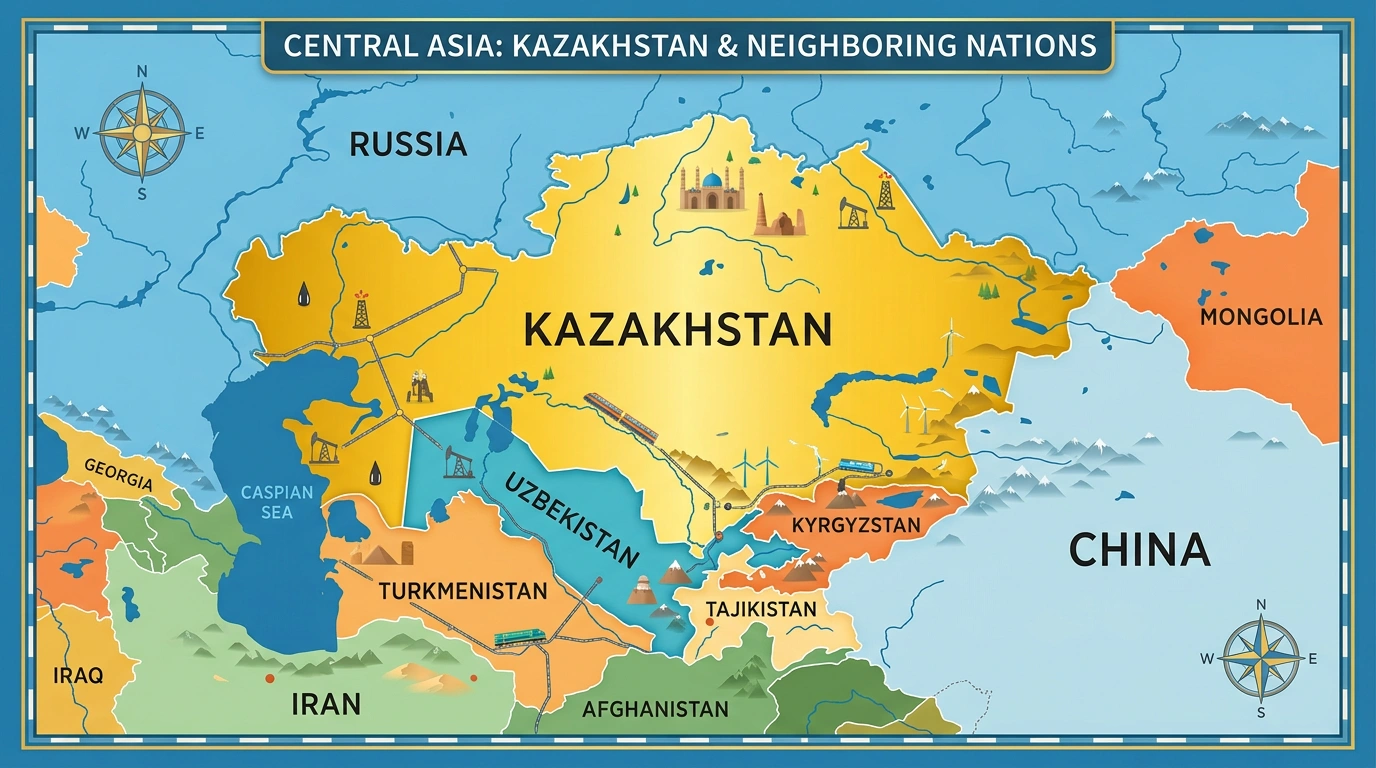
facts
Where Is Kazakhstan? Map, Size (9th Largest Country) & Borders
Kazakhstan is in Central Asia, bordering Russia, China, Kyrgyzstan, Uzbekistan, and Turkmenistan. 2.7 million km2, larger than Western Europe.

facts
What Is Kazakhstan Famous For? 15 Things That Surprise Visitors
Kazakhstan is famous for Baikonur Cosmodrome, Dimash's 6-octave voice, the original apple, Borat memes, and 11 more reasons travelers visit.
facts
Where Is Central Asia? 5 Countries, Map & Geography Guide
Where is Central Asia? 5 countries between Russia, China, and Iran covering 4 million km². Maps, borders, capitals, and why the region matters today.