Baursak: Kazakhstan's Golden Fried Bread (History, Recipe, Meaning)
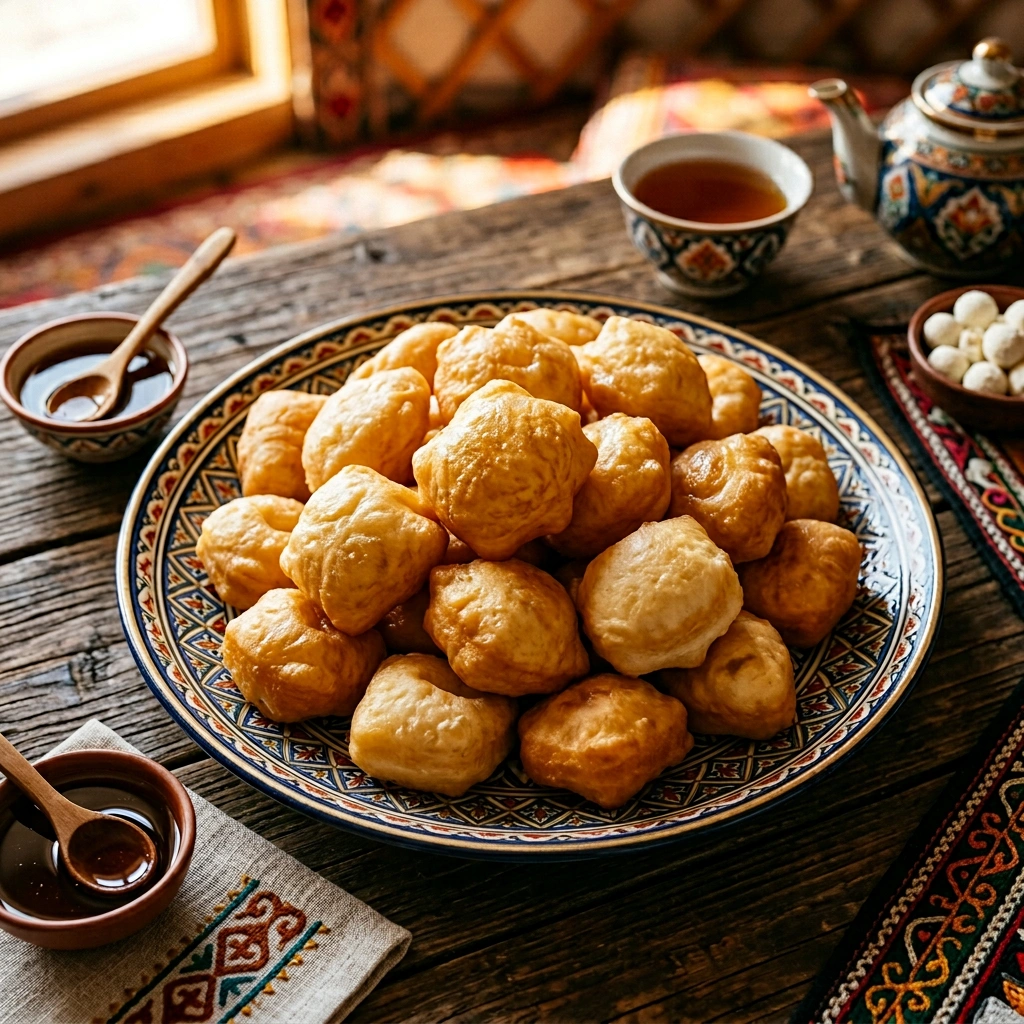
Baursak (Kazakh: бауырсақ) is a traditional Central Asian fried dough that has been the centerpiece of the Kazakh dastarkhan (feast table) for centuries. According to Wikipedia’s entry on baursak, the dish is shared across Turkic and Mongolic cultures throughout Central Asia and the Eurasian steppe. These golden, puffy pieces of bread, deep-fried in oil or animal fat, symbolize the sun, prosperity, and family unity in Kazakh culture. No celebration, holiday, or guest reception in Kazakhstan happens without a heaping plate of baursak on the table.
What Is Baursak?
Baursak is a simple fried bread made from dough (flour, milk or water, yeast, salt, sometimes eggs and butter) that is cut into small pieces and deep-fried until golden and puffy. The result is a light, airy bread with a thin crispy crust and soft interior.
The pieces can be round, diamond-shaped, or square depending on the region. They are typically 3 to 5 cm in size and are served warm, piled high on a plate or large dish. Baursak is eaten plain, with tea, dipped in honey, or alongside savory dishes like beshbarmak.
The name “baursak” comes from the Kazakh words “bauyr” (brother) and “bauyrlas” (to unite), reflecting the food’s role in bringing people together. Every baursak on the table symbolizes kinship, hospitality, and the warmth of shared meals.
History and Origins
Baursak has been part of Kazakh nomadic life for at least several centuries, originating as a practical travel food before becoming the most symbolically important bread in the culture. The transition from a steppe staple to a ceremonial centerpiece happened gradually as wheat flour became widely available in the 18th and 19th centuries.
Nomadic Roots
Baursak originated among the nomadic Turkic peoples of the Central Asian steppe. According to historian Saltanat Asanova (as reported by Tengrinews.kz), flour was considered a delicacy among Kazakh nomads, whose diet was primarily meat and dairy. The earliest versions were made from millet or roasted wheat, ground on hand mills and mixed with animal fat.
The genius of baursak for nomadic life was practical: fried in animal fat (usually mutton tallow), the bread could be stored for weeks without spoiling. This made it ideal for long journeys across the steppe, carried in leather saddlebags alongside kurt (dried cheese) and dried meat.
Evolution Through Contact
Baursak in its modern flour-based form became widespread after increased contact with Russian settlers in the 18th and 19th centuries, who brought wheat flour milling to the Kazakh steppe. According to UNESCO’s Intangible Cultural Heritage documentation on Central Asian culinary traditions, nomadic food practices across the steppe share deep structural similarities across Turkic cultures. Before that, nomads used rougher grains. The availability of refined flour transformed baursak from a travel staple into the festive centerpiece it is today.
Cultural Ritual
Baursak has always held ritual significance beyond simple nutrition. According to UNESCO’s Intangible Cultural Heritage program, food traditions that mark rites of passage are among the most enduring forms of living heritage. Baursak appears at every major life event:
- Weddings: Mountains of baursak are prepared, and the bride’s family traditionally demonstrates their hospitality through the quantity and quality of their baursak
- Funerals (as): Baursak is prepared and distributed to mourners as part of the communal meal
- Nauryz (March 21-23): The spring new year celebration requires fresh baursak on every table
- Guest reception (konakasy): The first thing offered to any guest, alongside kumis or tea
- Childbirth celebration (shildehana): Baursak is distributed to celebrate a new life
Regional Variations Across Kazakhstan
Baursak differs by region, and locals can often tell where a cook is from by the shape and style:
| Region | Shape | Size | Special Features |
|---|---|---|---|
| Northern Kazakhstan (Kostanay, Petropavl) | Square or diamond | Large (5-7 cm) | Denser, chewier texture; sometimes with onion |
| Southern Kazakhstan (Shymkent, Turkestan) | Round balls | Medium (3-4 cm) | Sometimes cottage cheese (tvorog) added to dough |
| Eastern Kazakhstan (Oskemen, Semey) | Small spheres | Small (2-3 cm) | Extra crispy, crunchy; fried longer |
| Western Kazakhstan (Aktau, Atyrau) | Mixed shapes | Medium | Fried in mutton fat (traditional method) |
| Almaty / Central | Round or diamond | Medium | Modern recipes with milk and eggs |
Special Varieties
- Shi baursak: A larger, flatter version that puffs up into a hollow pocket, popular in Almaty. Calorie count: approximately 407 kcal per serving
- Baursak on kefir: A yeast-free version using kefir for leavening, lighter and tangier. Approximately 490 kcal per serving
- Taba nan: A flat bread cousin cooked on a dry griddle, sometimes confused with baursak in southern regions
Classic Baursak Recipe
This is the traditional Kazakh recipe as prepared across most of the country.
Ingredients
| Ingredient | Amount | Notes |
|---|---|---|
| Wheat flour (highest grade) | 400 g (3 cups) | Sifted |
| Whole milk (warm) | 250 ml (1 cup) | Can substitute water |
| Vegetable oil (for dough) | 2 tbsp | Or melted butter |
| Dry yeast | 7 g (1 packet) | Or 15 g fresh yeast |
| Sugar | 1 tbsp | |
| Salt | 1 tsp | |
| Vegetable oil (for frying) | 500-700 ml | Or mix with mutton fat for traditional flavor |
Steps
- Activate yeast: Dissolve yeast and sugar in warm milk (40C). Wait 10 minutes until foamy
- Make dough: Combine flour and salt. Add yeast mixture and oil. Knead for 8-10 minutes until smooth and elastic
- Rise: Cover with a damp cloth, let rise in a warm place for 1 to 1.5 hours until doubled in size
- Shape: Punch down dough. Roll out to 1 cm thickness. Cut into diamonds or squares (3-4 cm), or tear off small pieces and roll into balls
- Fry: Heat oil to 170-180C in a deep pot (kazhan/казан). Fry baursak in batches, turning once, until golden brown on all sides (2-3 minutes per batch)
- Drain: Remove with a slotted spoon onto paper towels. Serve warm
Yield: 30-40 pieces. Calories: Approximately 234 kcal per 100 g.
Oil Temperature: The Critical Variable
Getting the oil temperature right is the single most important factor in baursak quality. The target range is 170-180°C (340-355°F). At this temperature, a piece of dough dropped into the oil will sink briefly, then rise and begin sizzling within 2-3 seconds.
- Below 160°C: Baursak absorbs excess oil and turns out greasy and heavy. The pieces will feel dense rather than light.
- 170-180°C (correct): Baursak puffs up fully, forms a thin golden crust, and stays light inside. Frying time is 2-3 minutes per batch.
- Above 190°C: The outside browns too fast while the inside remains raw dough. The pieces look golden but are undercooked at the center.
Use a kitchen thermometer for accuracy. If you don’t have one, test with a small dough piece every time before adding a full batch. Oil cools slightly when baursak pieces are added, so maintain heat between batches. A 4-liter pot with 700 ml of oil is ideal for batches of 8-10 pieces at a time.
Dough Resting: Why It Matters
The dough must rest for a full 1 to 1.5 hours before frying, and this step cannot be rushed. During this time, the yeast produces CO2 bubbles that remain trapped in the gluten network. These bubbles are what create the characteristic hollow, puffy interior when the dough hits hot oil.
- Under-proofed dough (less than 45 minutes): Baursak will be dense and bread-like with little puff.
- Properly proofed dough: The dough should double in volume. Press a finger into the surface; it should spring back slowly.
- Over-proofed dough (more than 2 hours at room temperature): Gluten weakens and the baursak may collapse flat when frying.
After shaping and cutting, allow the pieces to rest an additional 10-15 minutes on the board before frying. This second rest lets the cut surfaces relax and puff slightly, giving better results in the oil.
Tips from Kazakh Grandmothers
- Traditional cooks test oil by dropping in a small piece of dough. It should sink briefly, then rise to the surface sizzling within 3 seconds.
- For the lightest texture, don’t overwork the dough after the first rise. Gentle folding, not aggressive kneading.
- Add a teaspoon of vodka or cognac to the dough: a technique used in some Kazakh households that reduces oil absorption.
- Leftover baursak keeps 3-5 days at room temperature and 2-3 weeks in the refrigerator. The oil-saturated dough naturally resists mold, which made it valuable for long steppe journeys.
Baursak on the Kazakh Dastarkhan
The dastarkhan (Kazakh: дастарқан) is the communal feast table, and understanding its structure explains why baursak is so central to Kazakh food culture.
A traditional dastarkhan unfolds in a specific order:
- Tea and bread course: Baursak, kurt, irimshik (dried cottage cheese), raisins, nuts, candies, and jams are set on the table before guests sit down
- Appetizers: Cold meats, salads, and horsemeat dishes
- Main course: Beshbarmak (boiled meat on flat noodles) or other hot dishes
- Closing tea: More tea with baursak and sweets
Baursak is present from the very beginning to the very end of the meal. A dastarkhan without baursak is considered incomplete and disrespectful to guests.
Baursak Across Central Asia
While Kazakhstan claims baursak as quintessentially Kazakh, similar fried dough exists throughout the Turkic and Mongolic world. According to Wikipedia’s article on baursak, the dish is documented across Kazakhstan, Kyrgyzstan, Mongolia, and the Russian Turkic republics:
| Country | Name | Key Difference |
|---|---|---|
| Kazakhstan | Baursak / Бауырсақ | Yeast dough, round or diamond, served at all celebrations |
| Kyrgyzstan | Boorsok / Боорсок | Very similar, sometimes smaller and crunchier |
| Mongolia | Boortsog / Боорцог | Often made with butter, slightly sweeter |
| Uzbekistan | Bugirsak / Бўғирсоқ | Less common, typically for special occasions |
| Tatarstan | Baursak / Бавырсак | Can be sweetened, sometimes with honey glaze |
| Bashkortostan | Bauyra / Бауыра | Similar to Tatar version |
Where to Try Authentic Baursak in Kazakhstan
Home cooking: The best baursak is always homemade. If you are invited to a Kazakh home, you will almost certainly be served fresh baursak.
Restaurants in Almaty:
- Zheti Kazyna (traditional Kazakh cuisine, Almaty)
- Navat (Central Asian cuisine chain)
- Any restaurant serving Kazakh dastarkhan menu
Street food: During Nauryz (March 21-23) and other holidays, baursak is distributed free at public celebrations in every city.
Markets: Green Bazaar in Almaty and Dordoi Bazaar in other cities sell fresh baursak daily.
Cost: In restaurants, a plate of baursak costs 500-1,500 KZT ($1-3 USD). At markets, 1 kg costs approximately 800-1,200 KZT ($1.50-2.50).
Baursak in Modern Kazakhstan
Baursak has made a successful transition from nomadic staple to a thriving part of Kazakhstan’s contemporary food scene, appearing in everything from five-star restaurant menus to vacuum-sealed supermarket packs. The dish is no longer just home cooking; it has become a commercial product, a restaurant signature, and an icon of Kazakh national identity in the post-Soviet era.
Commercial Production
Kazakhstan’s food processing industry produces baursak at scale. Major supermarket chains including Magnum and Small and Medium carry pre-packaged baursak from producers based in Almaty, Astana, and Shymkent. According to industry estimates, the Kazakh traditional foods market (including baursak, kurt, and dried meat products) is worth over 15 billion KZT ($30 million USD) annually, with baursak among the top-selling categories.
Packaged baursak is frozen immediately after frying to preserve freshness, then sold in 300-500 g bags priced at 600-1,200 KZT ($1.20-2.50). The shelf life of commercially frozen baursak is up to 3 months. While convenient, most Kazakhs consider home-made or bazaar-fresh baursak superior in texture and flavor.
Restaurants and the New Kazakh Cuisine
The revival of Kazakh traditional cuisine in upscale restaurants, a trend that accelerated after Kazakhstan hosted the 2017 EXPO in Astana, has given baursak a new premium identity. Restaurants like Zheti Kazyna (Almaty) and Alasha (Astana) serve baursak with modern accompaniments: whipped butter infused with herbs, artisan honey, or housemade berry jams. A plate in such establishments costs 1,500-3,000 KZT ($3-6 USD).
According to Vist.kz, coverage of the 2017 EXPO food pavilions showed Kazakh traditional dishes including baursak were among the most photographed and praised by international visitors, helping elevate the dish’s profile abroad. The Almaty food tour scene routinely includes baursak demonstrations as a highlight.
Street Food and Holidays
Baursak retains its strongest cultural foothold in the street food and holiday context. During Nauryz (March 21-23), an estimated 5 million portions of baursak are prepared and distributed nationwide according to the Ministry of Culture’s Nauryz event reports. City squares across Kazakhstan set up large kazhan (cauldrons) and fry baursak continuously throughout the three-day holiday, distributing it free to crowds.
At Green Bazaar in Almaty, vendors fry fresh baursak throughout the day. A bag of 10-12 freshly fried pieces costs 400-600 KZT ($0.80-1.20), making it one of the most affordable traditional food experiences in the city.
Baursak as National Symbol
Kazakhstan’s government has actively promoted baursak as part of national cultural branding. The dish features prominently in the official “Visit Kazakhstan” tourism campaign materials, and Kazakh diplomatic missions abroad serve baursak at national day receptions. In 2023, Kazakhstan applied to UNESCO to inscribe several traditional culinary practices, with the dastarkhan tradition (of which baursak is the centerpiece) included in the submission.
Nutritional Information
Baursak is an energy-dense bread due to deep-frying, but portion sizes in traditional eating are moderate, typically 3-5 pieces alongside tea.
| Per 100 g | Value |
|---|---|
| Calories | 234 kcal |
| Protein | 4.5 g |
| Fat | 8.6 g |
| Carbohydrates | 34.7 g |
| Fiber | 1.2 g |
Baursak is calorie-dense due to frying. Traditional versions fried in mutton fat are richer. Modern lighter versions use kefir instead of yeast and are baked rather than fried.
Frequently Asked Questions
- What does baursak taste like?
- Baursak tastes like a cross between a donut and a dinner roll. It has a thin, crispy golden crust and a soft, airy interior. The flavor is mildly sweet and buttery when made with milk and eggs, or more neutral when made with just water and flour. Traditional versions fried in mutton fat have a distinctive savory richness.
- Is baursak the same as a donut?
- No, although they look similar. Baursak dough is less sweet than donut dough and uses less sugar and eggs. Baursak is a bread meant to accompany meals (especially tea and meat dishes), while donuts are a standalone sweet. The shape and size also differ: baursak are smaller (3-5 cm) and can be diamond-shaped, round, or square.
- How long does baursak stay fresh?
- Baursak stores remarkably well due to being saturated with frying oil. At room temperature, it stays good for 3-5 days. Refrigerated, it can last 2-3 weeks. This long shelf life is one reason nomads valued it for travel across the steppe. To refresh day-old baursak, briefly warm it in an oven or microwave.
- Why is baursak round?
- The round shape of baursak symbolizes the sun in Kazakh tradition. Each golden ball represents happiness and prosperity. However, baursak is not always round. In northern Kazakhstan it is typically diamond-shaped or square, while in the south it is round, and in the east it is shaped into small crispy spheres.
- When do Kazakhs eat baursak?
- Kazakhs eat baursak at virtually every gathering: weddings, funerals, Nauryz spring celebrations, guest receptions, childbirth celebrations, and regular family meals. It is the first food placed on the dastarkhan (feast table) before guests arrive. A table without baursak is considered incomplete and inhospitable.
- Can I buy baursak in Kazakhstan?
- Yes. Fresh baursak is available at bazaars (markets) across Kazakhstan for 800-1,200 KZT ($1.50-2.50) per kilogram. Restaurants serving Kazakh cuisine include it with most meals for 500-1,500 KZT ($1-3). During Nauryz (March 21-23), free baursak is distributed at public celebrations nationwide.
Last verified: March 2026
More Stories
food
Kurt: The Ancient Kazakh Snack That Sustained Nomads
Kurt is a traditional Kazakh dried yogurt ball that sustained nomads for centuries. Learn how kurt is made, its nutrition, taste, and cultural significance.
food
Beshbarmak: How Kazakhstan's National Dish Is Really Made and Eaten
Beshbarmak - Kazakhstan's national dish of boiled meat and noodles. Recipe, history, how to eat it properly, etiquette, and where to try authentic beshbarmak.
food
Manty: Kazakh Steamed Dumplings Recipe & Guide
Everything about Kazakh manty — traditional lamb filling, step-by-step recipe, folding technique, regional variations, and where to eat them.